Marrakech (مراكش) — the Red City, the Rose City, the City of Spices — is one of the world’s great travel destinations, an imperial city that has been captivating visitors since its founding in 1062 by the Almoravid sultan Abu Bakr ibn Umar. Set against the snow-dusted peaks of the High Atlas Mountains, its UNESCO-listed medina is a living medieval city of 700,000 people, 3,000 streets, and 100 mosques — a place where the 11th century and the 21st century collide with astonishing energy.
Marrakech is Morocco’s most visited city — receiving approximately 4 million international visitors per year — and for good reason: nowhere in Morocco, and arguably in Africa, concentrates so much beauty, history, art, food, and sensory intensity in a single place.
Marrakech’s medina was inscribed as a UNESCO World Heritage Site in 1985. The city’s name is the origin of the word ‘Morocco’ itself, derived from the Amazigh name ‘Amur n Akush’ (Land of God).
Getting to Marrakech
| By Air | Marrakech Menara Airport (RAK) — 6 km from the medina. Direct flights from 80+ European cities: London, Paris, Madrid, Amsterdam, Rome, Brussels |
| By Train | ONCF high-speed train from Casablanca (3 hrs) and Rabat (4.5 hrs) to Marrakech Gueliz station |
| By Bus | CTM and Supratours coaches from Casablanca (3 hrs), Agadir (3 hrs), Fes (8 hrs), and all major Moroccan cities |
| By Car | A7 motorway from Casablanca (240 km); A7 south to Agadir (260 km) |
Marrakech Neighbourhoods
The Medina — Old Marrakech
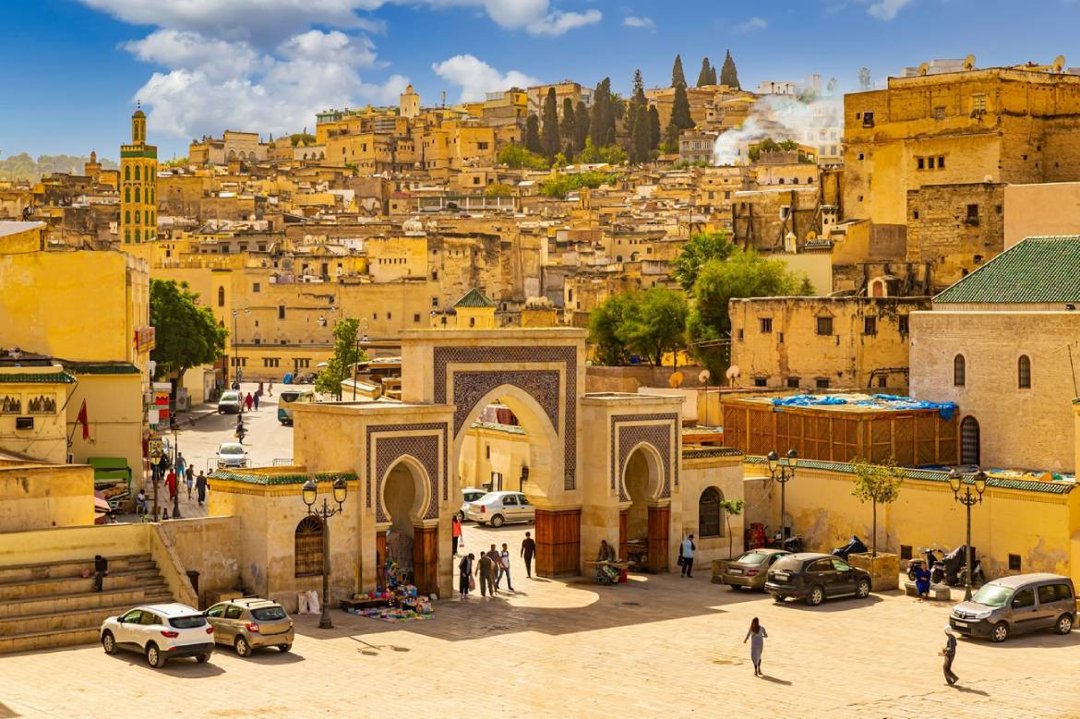
The medina is the original walled city, enclosed by 19 km of reddish-pink pisé (rammed earth) ramparts built in the 12th century. Within these walls lies the most intense concentration of monuments, souks, riads, and cultural life in all of Morocco. The medina is divided into quarters (derbs), each traditionally associated with a craft or ethnic community. Navigation within the medina is deliberately disorienting — it was designed so that invaders could not easily move through it — making getting ‘lost’ both inevitable and joyful.
Gueliz — The Ville Nouvelle
Built during the French Protectorate (1912–1956), Gueliz is Marrakech’s modern European-style quarter, laid out in a grid of wide boulevards lined with plane trees, cafes, restaurants, art galleries, and the city’s main shopping streets. It is home to most of Marrakech’s upscale restaurants, rooftop bars, designer boutiques, and the Mohammed VI Museum of Modern Art (opened 2024).
Hivernage
Hivernage is Marrakech’s luxury hotel and entertainment district, immediately south of Gueliz, home to the city’s 5-star palace hotels (Royal Mansour, La Mamounia, Mandarin Oriental, Four Seasons), the Palais des Congrès convention centre, and the city’s main nightclubs.
Top Attractions in Marrakech
1. Jemaa el-Fna Square
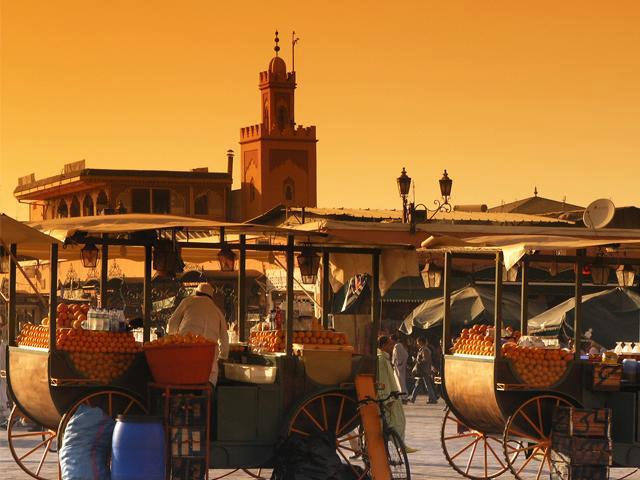
The ‘Assembly of the Dead’ — now more cheerfully UNESCO-listed as a Masterpiece of the Oral and Intangible Heritage of Humanity — is the pulsating heart of Marrakech. By morning: fresh orange juice, herbal remedy sellers, and acrobats. By noon: food vendors setting up charcoal grills. By dusk: hundreds of stalls selling everything from snails to merguez sausages; storytellers (halaiqa) performing for circles of listeners; Gnawa musicians in blue robes playing guembri bass lutes. By night: the most atmospheric outdoor dining in the world.
2. The Souks
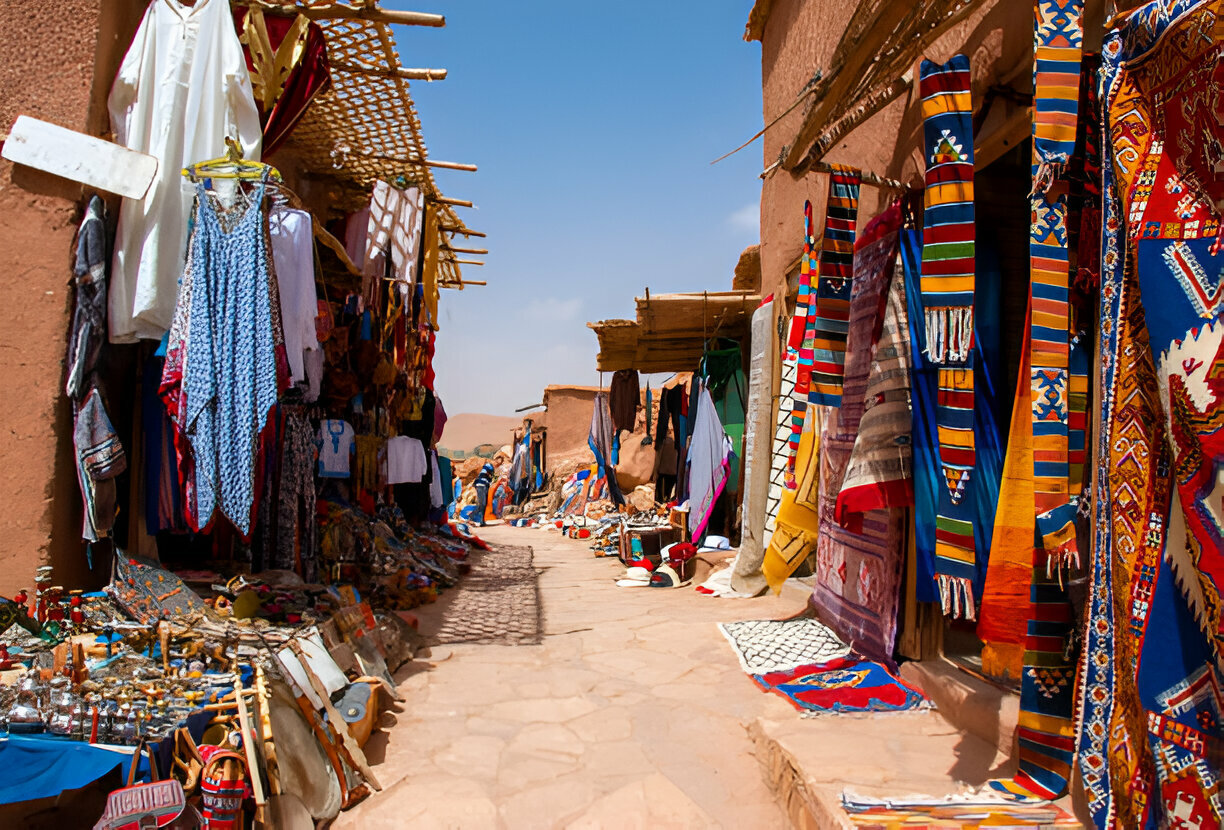
North of Jemaa el-Fna, the souks of Marrakech form a labyrinthine covered marketplace where craftspeople and merchants have traded for a thousand years. Each area specialises: the Souk Semmarine for textiles; Souk Chouari for woodworkers; Souk des Teinturiers (Dyers’ Souk) for vividly coloured yarn; Souk Zrabia for carpets; Souk des Bijoutiers for silver jewellery. Bargaining is expected and part of the ritual — opening prices are typically 3–5× the fair price.
3. Bahia Palace
Built in the late 19th century by Grand Vizier Si Moussa and his son Ba Ahmed, the Bahia Palace (‘Palace of the Brilliant’) is a masterpiece of Moroccan and Andalusian architecture spread across 8,000 m² of salons, apartments, gardens, and courtyards. The name refers to the Grand Vizier’s favourite concubine. Despite being built in just a few decades, it represents the peak of Moroccan palace craft: hand-painted cedarwood ceilings, intricate zellij tilework floors, carved plaster walls, and tranquil inner gardens.
4. Majorelle Garden & Yves Saint Laurent Museum
The Jardin Majorelle is one of Marrakech’s most beloved spaces — a 1.2-hectare botanical garden designed from the 1920s by French painter Jacques Majorelle, featuring over 300 plant species from five continents, bamboo groves, cactus gardens, and pools of koi fish, all set against structures painted in the vivid cobalt blue that has come to be called ‘Majorelle Blue.’ In 1980, the garden was saved from property developers by fashion designers Yves Saint Laurent and Pierre Bergé. Today it houses the Berber Museum and, adjacent, the Yves Saint Laurent Museum.
5. Koutoubia Mosque
The Koutoubia (كتبية) is the largest mosque in Marrakech and one of the masterpieces of Almohad architecture. Its 70-metre minaret, built in the 12th century, served as the model for the Giralda in Seville, Spain, and the Hassan Tower in Rabat. Non-Muslims cannot enter the mosque, but the surrounding gardens and the exterior view of the minaret — particularly stunning at sunset — are freely accessible and essential.
6. Saadian Tombs
The Saadian Tombs were the royal necropolis of the Saadian dynasty (16th–17th century), sealed by the Alaouite Sultan Moulay Ismail in the 17th century and not rediscovered until 1917. The main chamber, the Hall of Twelve Columns, contains the tombs of Sultan Ahmad al-Mansur and his family in a space of extraordinary beauty: Italian Carrara marble columns, intricate carved plaster, cedar muqarnas ceilings, and zellige tiled floors.
Where to Eat in Marrakech
- Nomad — Modern Moroccan rooftop restaurant in the medina; excellent for Instagram and flavour
- Le Jardin — A tranquil garden restaurant behind the souks; fresh salads and Moroccan classics
- Cafe de France — Classic 1930s café on Jemaa el-Fna; perfect for people-watching
- Jemaa el-Fna food stalls — Numbers 1–100 serve harira, lamb brochettes, snails, calamari from sunset to midnight
- Pepe Nero — Excellent fusion of Italian and Moroccan; popular with international visitors in Gueliz
- Souk Kafé — Hidden rooftop in the souks; one of Marrakech’s best kept secrets
Where to Stay in Marrakech
| Ultra-luxury | Royal Mansour — Morocco’s most exclusive hotel, built by King Mohammed VI; each of 53 riads has a private rooftop pool |
| Luxury | La Mamounia — The legendary grande dame of Marrakech hotels since 1923; Churchill’s favourite |
| Boutique riad | Riad Yasmine — Instagram-famous pool riad in the medina; excellent value |
| Mid-range | Riad Kniza — 18th century palace; excellent location near Bab Doukkala |
| Budget | Equity Point Marrakech — Popular hostel with rooftop pool near Jemaa el-Fna |
Day Trips from Marrakech
- Ourika Valley (35 km) — Atlas Mountain valley with Berber villages and waterfalls; half-day
- Ait Benhaddou (190 km) — UNESCO ksar; combine with Ouarzazate; full day
- Essaouira (240 km) — Atlantic port city; 2.5 hours; best done overnight
- Imlil & Jebel Toubkal (60 km) — Base camp for Atlas trekking; overnight recommended
- Agafay Desert (35 km) — Rocky desert landscape outside Marrakech; sunset camel rides and luxury camps
Practical Tips for Marrakech
- Dress code: Shoulders and knees covered when visiting mosques or the medina; the Jemaa el-Fna area is more relaxed
- Currency: Moroccan Dirham (MAD); ATMs widely available in Gueliz; medina vendors may prefer cash
- Language: Arabic and French are primary; basic French or Arabic phrases are appreciated; English is widespread in tourist areas
- Transport: Petit taxis (metered, beige) within the city; Careem for app booking; horse-drawn calèches around the ramparts
- Safety: Marrakech is generally very safe; the main issue is aggressive touting in the souks — a firm ‘la shukran’ (no thank you) is effective
- Best season: March–May and September–November; summer is very hot (35–45°C); winter is mild and pleasant