Morocco desert tours are organised travel trips that take visitors into the Sahara Desert, the largest hot desert on Earth, located in the southern region of Morocco. These tours begin in Morocco’s imperial cities — Marrakech, Fes, or Casablanca — and travel south through ancient kasbahs, dramatic mountain passes, and palm-lined river valleys until they reach the towering golden dunes of the Sahara.
Morocco is one of the only countries in the world where travellers can experience a Saharan desert landscape while staying within a single country that also offers Atlantic beaches, snow-capped Atlas Mountains, and UNESCO-listed medinas. This geographic diversity makes Morocco desert tours among the most popular travel experiences in Africa and the Mediterranean world.
This guide covers everything you need to know before booking a Morocco desert tour: where the desert is located, which type of tour suits you, the best destinations, activities, accommodation, costs, the ideal time to visit, and how to travel safely.
Where is the Desert in Morocco?
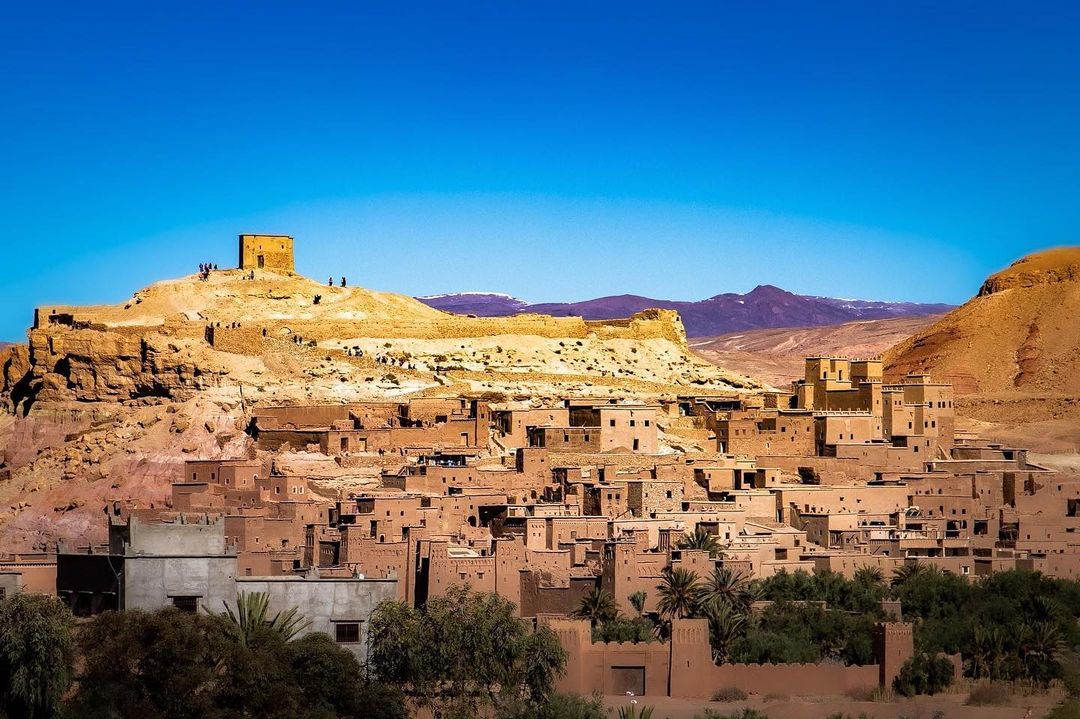
The desert in Morocco is located in the southern and southeastern part of the country, within the Draa-Tafilalet administrative region. This region borders Algeria to the east and shares the northern edge of the Sahara Desert. The desert landscape begins after crossing the High Atlas Mountains via the Tizi n’Tichka or Tizi n’Tinifift mountain passes, dropping into a landscape of black volcanic plains, lush palm oases, ancient fortified villages (ksour), and ultimately the towering sand dunes of the Sahara.
| Desert Location at a Glance |
| 📍 Region: Draa-Tafilalet, southeastern Morocco |
| 📍 Borders: Algeria (east), High Atlas Mountains (north) |
| 📍 Main gateway cities: Marrakech, Fes, Ouarzazate |
| 📍 Distance from Marrakech: ~560 km / ~9–10 hours by road |
| 📍 Distance from Fes: ~350 km / ~6–7 hours by road |
| 📍 Coordinates of Erg Chebbi (Merzouga): 31.0843° N, 4.0124° W |
What Desert is in Morocco?
The desert in Morocco is the Sahara Desert — the world’s largest hot desert, covering approximately 9.2 million km² across North Africa. Within Morocco, the Sahara manifests primarily in two spectacular sand dune formations (ergs):
Erg Chebbi, located near the village of Merzouga in the Errachidia Province, is Morocco’s most famous and most visited dune sea. Its dunes rise up to 150 metres (490 feet) above the surrounding hammada (rocky desert plain) and stretch approximately 22 km in length and 5 km in width. The iron oxide in the sand gives these dunes their signature deep orange-red colour, which glows brilliantly at sunrise and sunset.
Erg Chigaga, located near the village of M’hamid El Ghizlane in the Zagora Province, is Morocco’s largest and most remote dune sea. It covers approximately 40 km in length and is only accessible via a 2-hour 4WD drive or camel trek across rocky desert terrain. Erg Chigaga sees significantly fewer tourists than Erg Chebbi, making it the preferred destination for travellers seeking a more authentic, undisturbed desert experience.
Beyond the two main ergs, Morocco’s desert region also includes draa (dry riverbeds), reg (flat gravel plains), and hammada (rocky plateaus). The Draa Valley, stretching 200 km from Ouarzazate to M’hamid, is one of the longest oasis valleys in Morocco and forms a crucial corridor on the historic trans-Saharan trade routes.
Where is Merzouga Located?
Merzouga is a small village in the Errachidia Province of southeastern Morocco, situated at the foot of the Erg Chebbi dunes. Its precise geographic coordinates are 31.0804° N, 4.0099° W. Merzouga sits at an elevation of approximately 1,044 metres (3,425 feet) above sea level.
Merzouga is located approximately 560 km from Marrakech (9–10 hours by road via Ouarzazate), approximately 350 km from Fes (6–7 hours by road via Midelt), and approximately 50 km from the Algerian border. The town has no commercial airport; the nearest airports are Errachidia Airport (ERH), 80 km away, and Ouarzazate Airport (OZZ), 330 km away.
Merzouga is the primary base for Erg Chebbi tours and serves as the main overnight stop for the majority of Morocco desert tour itineraries. The village is home to over 100 desert camps, riads, and hotels, ranging from standard budget camps to luxury glamping resorts.
What are the Types of Morocco Desert Tours?
Morocco desert tours are available in several types, ranging from short day excursions to week-long private expeditions. The right tour type depends on your available time, budget, desired level of comfort, and how deeply you want to explore the desert landscape.
| Tour Type | Duration | Best For | Price Range (per person) |
| Sahara Day Trip | 1 day | Short stopover travellers | $80–$140 |
| 2-Day / 1 Night | 2 days | Weekend visitors | $130–$250 |
| 3-Day Desert Tour | 3 days | First-time visitors | $200–$400 |
| 5-Day Desert Tour | 5 days | Deeper exploration | $350–$700 |
| 7+ Day Grand Tour | 7+ days | Comprehensive travellers | $600–$1,400 |
| Private Desert Tour | 1–14 days | Families, couples, groups | $250–$1,500+ |
| Luxury Desert Tour | 2–7 days | Premium experience seekers | $500–$2,000+ |
What is a Sahara Desert Day Trip from Marrakech?
A Sahara desert day trip from Marrakech is a single-day excursion that departs Marrakech early in the morning and returns the same evening. Because the Sahara is approximately 560 km from Marrakech, a true day trip to the Erg Chebbi dunes is not feasible in a single day by road. As such, “Sahara day trips from Marrakech” typically travel to the Agafay Desert, a rocky moonscape desert located only 40 km southeast of Marrakech, or reach as far as the Draa Valley and Zagora, which is 370 km from Marrakech (roughly 5 hours each way).
A standard Marrakech Sahara day trip includes: private vehicle transport, a local English-speaking guide, a camel ride or quad bike experience, a traditional Moroccan lunch, and a sunset viewpoint visit. Day trips typically depart between 06:00 and 08:00 and return to Marrakech between 20:00 and 23:00. Price range: $80–$140 per person.
What is a 3-Day Morocco Desert Tour?
A 3-day Morocco desert tour is the most popular format for first-time visitors and covers the full route from Marrakech to Merzouga (Erg Chebbi) and back, or as a one-way transfer to Fes. The 3-day itinerary typically follows this route:
Day 1: Marrakech → Ait Benhaddou (UNESCO kasba) → Ouarzazate (the “Hollywood of Africa”) → Dades Gorge or Skoura. Overnight at Dades Gorge.
Day 2: Dades Gorge → Todra Gorge → Erfoud (fossil centre) → Merzouga → Erg Chebbi dunes. Sunset camel trek to desert camp. Overnight at a Berber desert camp.
Day 3: Sunrise in the dunes → Breakfast at camp → Return to Marrakech or continue to Fes via Midelt and the Middle Atlas Mountains.
The 3-day tour covers approximately 1,000–1,200 km of driving. Price range: $200–$400 per person (including transport, guide, accommodation, and camel trek).
What is a 5-Day Morocco Desert Tour?
A 5-day Morocco desert tour allows for a significantly deeper experience of southern Morocco, with extra time at key stops and additional destinations. A standard 5-day itinerary follows this structure:
Day 1: Marrakech → Tizi n’Tichka mountain pass → Ait Benhaddou → Ouarzazate. Overnight in Ouarzazate.
Day 2: Ouarzazate → Skoura palm grove → Roses Valley (El Kelaa M’Gouna) → Dades Gorge. Overnight in Dades.
Day 3: Dades Gorge → Todra Gorge → Erfoud → Rissani (historic market town) → Merzouga. Camel trek at sunset. Overnight in desert camp at Erg Chebbi.
Day 4: Sunrise walk on the dunes → Khamlia Gnawa music village → Merzouga Lake (seasonal, flamingos) → Free afternoon in the dunes. Second overnight in Merzouga.
Day 5: Merzouga → Midelt → Ifrane (Switzerland of Morocco) → Fes or return to Marrakech.
The 5-day format is recommended for travellers who want to spend two full nights in the Sahara and explore the cultural landscape of the Draa-Tafilalet region at a relaxed pace. Price range: $350–$700 per person.
What is a Private Morocco Desert Tour?
A private Morocco desert tour is a fully customised desert itinerary operated exclusively for one group — typically a couple, family, or small group of friends — with a dedicated vehicle and guide. Unlike group tours, private tours have no fixed departure dates, no other passengers, fully flexible itineraries, and personalised stops.
Private tours typically use comfortable 4WD vehicles (Toyota Land Cruiser, Mercedes Sprinter minivan, or similar) and can include upgrades such as luxury riads for overnight stays, private desert camp tents, helicopter transfers, and bespoke cooking experiences. Private tours are available at any duration from 1 to 14 days. Price range: $250–$1,500+ per person depending on group size, duration, and luxury level.
What are the Best Desert Destinations in Morocco?
Morocco’s desert region contains multiple distinct destinations, each offering a different character of desert experience. The four primary desert destinations are Merzouga (Erg Chebbi), Zagora, M’hamid El Ghizlane (Erg Chigaga), and Ouarzazate — the gateway city to the entire desert south.
| Destination | Desert Type | Dune Height | Accessibility | Best For |
| Merzouga / Erg Chebbi | Sand dunes (erg) | Up to 150 m | Paved road from Marrakech | First-timers, photography |
| Zagora | Mixed (sand & rock) | 20–30 m | Paved road via Draa Valley | Short trips from Marrakech |
| M’hamid / Erg Chigaga | Sand dunes (erg) | Up to 100 m | 4WD track only | Off-grid, authentic experience |
| Ouarzazate | Pre-desert plateau | N/A | Paved road, airport | Filming location, kasbahs |
What is Erg Chebbi?
Erg Chebbi is the most visited dune sea in Morocco and one of the most photographed desert landscapes in the world. It is located near the village of Merzouga in the Errachidia Province of southeastern Morocco, approximately 560 km from Marrakech. The dunes of Erg Chebbi rise to a maximum height of approximately 150 metres (490 feet) above the surrounding flat rocky plain and stretch approximately 22 km in length and 5 km in width.
The dunes of Erg Chebbi are composed of extremely fine-grained quartz sand mixed with iron oxide, which gives the dunes their iconic deep orange-red colour. This colour intensifies dramatically at sunrise and sunset, creating photographic conditions unlike anywhere else in North Africa. The highest dune in Erg Chebbi is located at the southern end and can be climbed on foot in approximately 45–60 minutes.
Erg Chebbi receives approximately 250,000–300,000 tourists annually, making it one of Morocco’s most visited natural attractions. The village of Merzouga at its western edge contains the full range of accommodation options from backpacker hostels to five-star glamping resorts. A large seasonal lake, Dayet Srji, forms at the northern edge of Erg Chebbi after winter rains and attracts pink flamingos between November and March.
What is Erg Chigaga?
Erg Chigaga is Morocco’s largest and most remote dune sea, located approximately 60 km west of the village of M’hamid El Ghizlane in the Zagora Province of southeastern Morocco. Unlike Erg Chebbi, Erg Chigaga cannot be reached by paved road; access requires either a 2–3 hour drive in a 4WD vehicle across a rocky piste (track), or a 2-day camel trek from M’hamid.
Erg Chigaga stretches approximately 40 km in length and contains dunes up to 100 metres (330 feet) high. Because of its remote access, Erg Chigaga receives only a fraction of the visitors that Erg Chebbi attracts — typically experienced desert travellers, overlanders, and those seeking solitude. There are no villages or paved infrastructure within the dune field itself; the only accommodation consists of a small number of semi-permanent luxury camps and bivouacs.
Erg Chigaga is widely considered by desert guides and experienced travellers to offer a more authentic Saharan experience than Erg Chebbi. The complete absence of roads, electricity infrastructure, and large tourist camps creates a silence and sense of remoteness that is increasingly difficult to find in the Sahara.
What is a Zagora Desert Tour?
A Zagora desert tour is a Morocco desert tour that targets the Zagora Province and the Draa Valley rather than the Merzouga region. Zagora is located approximately 370 km (5 hours) south of Marrakech via the Tizi n’Tichka pass and the Draa Valley road. It is significantly closer to Marrakech than Merzouga, making it the preferred option for travellers on tight schedules who want a genuine desert overnight experience.
The desert landscapes around Zagora are more varied than those of Merzouga and include the Draa Valley oasis (one of Morocco’s longest, at over 200 km), small sand dune formations at Tinfou (25 km south of Zagora), and access to the larger Erg Chigaga dunes at M’hamid El Ghizlane (98 km south of Zagora). A standard 2-day / 1-night Zagora desert tour from Marrakech includes: Ait Benhaddou, Ouarzazate, the Draa Valley, a camel ride near Zagora or Tinfou, an overnight in a Berber camp, and the return to Marrakech.
What Activities are Included in Morocco Desert Tours?
Morocco desert tours include a wide range of activities for different interests and fitness levels. The following are the most common activities included or available as optional add-ons in a standard desert tour package.
What is Camel Trekking in the Sahara?
Camel trekking is the signature activity of Morocco desert tours and is included as standard in the vast majority of tour packages. Travellers mount dromedary camels (Camelus dromedarius — the single-humped camel native to North Africa) led by a Berber guide on foot, and ride from the edge of the dunes to an overnight desert camp. Standard camel treks at Erg Chebbi last approximately 45–90 minutes each way and depart timed to coincide with the sunset for the ride in and the sunrise for the ride out.
Extended camel trekking expeditions lasting 2–7 days are also available, following traditional Saharan trade routes across the desert from Merzouga to M’hamid or from M’hamid into Erg Chigaga. Multi-day camel treks include overnight bivouac camping under the stars, Berber meals cooked on open fires, and navigation by the stars with experienced nomadic guides.
What is Sandboarding in Morocco?
Sandboarding is the desert equivalent of snowboarding and involves descending sand dunes on a specially designed board. Sandboarding is available at Erg Chebbi (Merzouga) and at some Zagora dune locations as an optional activity, typically arranged through your desert camp or hotel. Equipment — a waxed wooden board or foam bodyboard — is provided by the camp or a local rental operator.
The highest dunes of Erg Chebbi (south section) provide the best sandboarding conditions. The activity requires no prior experience and is suitable for most fitness levels. The main physical challenge is climbing the dune before descending. A single sandboarding session of 1–2 hours costs approximately $15–$30 per person and can be combined with a sunset camel trek as part of a dual-activity afternoon.
What is Stargazing in the Sahara Desert?
The Sahara Desert surrounding Merzouga and M’hamid ranks among the best stargazing locations on Earth. The extreme remoteness from light pollution, combined with the Sahara’s characteristically clear, dry atmosphere and very low humidity, produces exceptional night sky visibility. The Milky Way is visible to the naked eye on most clear nights between October and March.
Stargazing is included as an informal activity in all overnight desert camp packages — the desert camps are located far enough from Merzouga village to avoid local light interference. Some luxury camps offer guided astrophotography sessions and telescope access as premium add-ons. The best stargazing months are October, November, February, and March, when skies are clearest and temperatures are comfortable after dark.
Where to Stay During Morocco Desert Tours?
Accommodation during Morocco desert tours ranges from traditional Berber bivouac camps under canvas to boutique luxury glamping resorts with private plunge pools. The type of accommodation is one of the most significant variables in the price and experience quality of a Morocco desert tour.
| Type | Price/Night (per person) | Facilities | Best For |
| Budget Berber Camp | $25–$60 | Shared bathroom, basic tent, communal dinner | Backpackers, budget travellers |
| Standard Desert Camp | $60–$120 | En-suite tent, dinner & breakfast, campfire | Most tour packages |
| Superior Camp | $120–$200 | Large tents, private bathroom, WiFi, pool | Couples, comfortable travellers |
| Luxury Glamping | $200–$500+ | Air-con, premium furnishings, gourmet meals | Honeymoons, luxury seekers |
| Desert Riad (Merzouga) | $60–$200 | Hotel-standard rooms, rooftop terrace | Those who prefer solid walls |
What is a Luxury Desert Camp in Morocco?
A luxury desert camp in Morocco is a semi-permanent glamping resort located within or at the edge of the Sahara dunes, offering hotel-standard amenities in a desert setting. Morocco’s luxury desert camps have expanded significantly since 2015 and represent one of the most distinctive hospitality experiences in North Africa.
Luxury desert camps in Morocco typically feature: private Berber-style canvas tents of 30–60 square metres with solid wooden floors, en-suite bathrooms with flush toilets and hot showers, king-size beds with premium linen, air conditioning or ceiling fans, private terrace areas with dune views, gourmet Moroccan dining (3-course dinners, Berber breakfast), swimming pool (heated in winter at some properties), evening Gnawa or Berber music performances, and private guided sunrise/sunset experiences. Price range: $200–$500+ per person per night, typically including dinner and breakfast.
Notable luxury desert camp areas include the southern section of Erg Chebbi dunes, approximately 4–6 km from Merzouga village, where the dunes are highest and the camp locations most photogenic.
What is a Standard Berber Camp in Morocco?
A standard Berber desert camp is the most common accommodation type included in mainstream Morocco desert tour packages. These camps consist of 10–30 canvas or fabric tents arranged in a circle around a communal fire pit, located within or at the edge of the Sahara dunes, typically 1–3 km from Merzouga village.
A standard Berber camp typically provides: a private double or twin tent with basic furniture (beds, mattresses, blankets), a shared bathroom block with flush toilets and cold or warm showers, a communal dining tent with a set Moroccan dinner (tagine, salad, bread, mint tea, fruit), a campfire with Berber drumming and music, a guided morning camel trek back to Merzouga, and a continental or Moroccan breakfast. Price range: $60–$120 per person per night including dinner and breakfast.
What is the Best Time to Visit Morocco Desert?
The best time to visit the Morocco desert is during spring (March to May) and autumn (September to November), when daytime temperatures are warm and pleasant, night temperatures are comfortable, and skies are reliably clear. These shoulder seasons offer the ideal balance between weather, crowd levels, and photographic conditions.
| Month | Daytime Temp | Night Temp | Conditions | Recommendation |
| January | 15–18°C / 59–64°F | 1–4°C / 34–39°F | Cold nights, clear skies | Good (warm layers essential) |
| February | 18–22°C / 64–72°F | 3–7°C / 37–45°F | Warming up, clear | Very Good |
| March | 22–27°C / 72–81°F | 8–12°C / 46–54°F | Pleasant, ideal | Best Season |
| April | 26–30°C / 79–86°F | 12–16°C / 54–61°F | Warm, pleasant | Best Season |
| May | 30–35°C / 86–95°F | 17–21°C / 63–70°F | Warming, still fine | Good |
| June | 36–42°C / 97–108°F | 22–26°C / 72–79°F | Hot, hazy | Avoid if heat-sensitive |
| July | 40–48°C / 104–118°F | 25–30°C / 77–86°F | Extreme heat | ❌ Avoid |
| August | 40–46°C / 104–115°F | 24–28°C / 75–82°F | Extreme heat, sandstorms | ❌ Avoid |
| September | 35–38°C / 95–100°F | 19–23°C / 66–73°F | Cooling, still warm | Good |
| October | 28–32°C / 82–90°F | 13–17°C / 55–63°F | Very pleasant, clear | Best Season |
| November | 22–26°C / 72–79°F | 7–11°C / 45–52°F | Ideal conditions | Best Season |
| December | 17–20°C / 63–68°F | 3–6°C / 37–43°F | Cool, quiet season | Good (quiet & atmospheric) |
What is the Weather Like in the Sahara Morocco?
The Sahara Desert in Morocco has an extreme desert climate (Köppen classification BWh), characterised by very high summer temperatures, very cold winter nights, minimal rainfall, very low humidity, and strong seasonal winds. Annual rainfall at Merzouga averages only 30–50 mm (1.2–2 inches) — less than 10% of the UK average — falling mainly in brief winter storms between November and February.
Summer (June–August) daytime temperatures at Erg Chebbi regularly exceed 40°C (104°F) and can reach as high as 48°C (118°F) during heat waves. This makes outdoor desert activities such as camel trekking dangerous for untrained visitors during midday and afternoon hours. Night temperatures in summer remain warm at 24–30°C (75–86°F).
Winter nights (December–February) can be extremely cold at the dunes, with temperatures dropping to near 0°C (32°F) or occasionally below. However, winter days are bright and clear with comfortable temperatures of 15–20°C (59–68°F), making daytime activities pleasant. Quality desert camps provide heavy blankets and may offer heating in premium accommodation.
What Months to Avoid in Morocco Desert?
July and August are the months most strongly recommended to avoid for Morocco desert tours. During these months, daytime temperatures in the Erg Chebbi area consistently reach 42–48°C (108–118°F), making any outdoor activity — including walking between the hotel or camp and the dunes — genuinely dangerous without significant heat acclimatisation.
In addition to extreme heat, July and August in the Sahara frequently bring chergui winds — hot, dry, dust-laden winds from the southeast that reduce visibility, cover surfaces in fine sand, and make photographic conditions very poor. The intense heat also affects wildlife; scorpions and desert snakes are significantly more active during the summer months, requiring extra vigilance.
How to Get to the Morocco Desert?
There are four main ways to travel from Morocco’s major cities to the Sahara Desert: by organised tour vehicle (recommended), by private hire transfer, by public bus, or by rental car. The vast majority of visitors travel as part of an organised desert tour, as the routes are long and the scenic value of the journey itself is a major part of the experience.
How Far is Marrakech from the Sahara Desert?
Marrakech is approximately 560 km (348 miles) from Merzouga (Erg Chebbi), making it the furthest of Morocco’s main cities from the central Sahara. By road, the journey takes approximately 9–10 hours without stops via the most direct route: Marrakech → Tizi n’Tichka pass (2,260 m) → Ouarzazate → Skoura → Dades Gorge → Tinghir → Erfoud → Merzouga.
An alternative, slightly shorter route runs via Tizi n’Tinifift → Agdz → Zagora → Mhamid, which accesses the western Sahara (Zagora, Erg Chigaga) rather than the Merzouga dunes. All organised desert tours from Marrakech split the drive over 2–3 days with scenic stops at Ait Benhaddou, Ouarzazate, Dades Gorge, and Todra Gorge, meaning the drive itself is an integral part of the experience rather than a challenge to endure. For more information read the article : Transport Guide from Marrakech to Merzouga and Beyond.
How Far is Fes from the Sahara Desert?
Fes is approximately 350 km (217 miles) from Merzouga (Erg Chebbi), making it the closest of Morocco’s imperial cities to the Sahara. The drive takes approximately 6–7 hours via the most direct route: Fes → Ifrane → Midelt → Errachidia → Erfoud → Rissani → Merzouga.
Many Morocco desert tour itineraries are designed as one-way routes from Marrakech to Fes (or Fes to Marrakech), with the Sahara as the midpoint. This allows travellers to avoid retracing their route and to visit the maximum variety of landscapes and UNESCO sites in a single journey.
How Much Does a Morocco Desert Tour Cost?
The cost of a Morocco desert tour depends on four main variables: duration, group size, accommodation level, and whether the tour is private or shared. Morocco is a relatively affordable destination for desert tourism compared to alternatives such as Egypt, UAE, or Australia’s Outback, and high-quality tours are available at every price point.
| Tour Type | Duration | Shared (per person) | Private (per person) |
| Agafay / Zagora Day Trip | 1 day | $50–$90 | $120–$200 |
| 2-Day / 1-Night Tour | 2 days | $100–$180 | $200–$350 |
| 3-Day Desert Tour (Marrakech) | 3 days | $150–$280 | $280–$500 |
| 5-Day Desert Tour | 5 days | $280–$450 | $450–$800 |
| 7-Day Grand Tour | 7 days | $450–$700 | $700–$1,400 |
| Luxury Private Tour (5 days) | 5 days | N/A | $1,000–$2,500 |
Standard inclusions in Morocco desert tour packages: 4WD or minivan transport, English-speaking guide, accommodation (riad + desert camp), camel trek, most meals (dinner and breakfast at minimum).
Standard exclusions: International flights, travel insurance, personal spending, tips for guide and driver (recommended: $5–$10 per person per day), optional activities (sandboarding, quad biking), single-room supplement, and lunches on driving days.
Are Morocco Desert Tours Worth It?
Morocco desert tours represent exceptional value relative to comparable desert experiences globally. The combination of a UNESCO-listed ancient medina (Fes or Marrakech), dramatic Atlas Mountain scenery, historic kasbahs and Hollywood filming locations (Ouarzazate), and the Sahara Desert dunes — all accessible via a single continuous road journey — makes Morocco one of the world’s most diverse multi-landscape destinations.
Compared to Saharan experiences in Egypt (Western Desert), Tunisia (Douz), or the UAE (Dubai desert safaris), Morocco offers greater cultural depth, more dramatic dune landscapes (particularly Erg Chebbi), significantly more accommodation variety, and a longer and more scenic approach journey. For travellers choosing between Morocco and these alternatives, Morocco consistently ranks highest for overall experience value at comparable price points.
What is Included in a Morocco Desert Tour Package?
A standard Morocco desert tour package (3 days from Marrakech) typically includes the following: return private or shared 4WD transport between Marrakech and Merzouga; an English-speaking driver-guide for the full duration; accommodation on a bed-and-breakfast basis at hotels or riads on the route; one full-board overnight at a Berber desert camp (dinner + breakfast); a sunset camel trek from Merzouga to the desert camp; and entry to outdoor viewing points along the route.
Not included in standard packages (typically): flights to/from Morocco; travel insurance (strongly recommended and required by some operators); alcoholic beverages; lunches on driving days; entry fees to UNESCO sites such as the Ait Benhaddou kasbah ($1–$2); tips; and optional activities such as sandboarding ($15–$30), quad biking ($30–$60), or hot air balloon flights over the dunes ($150–$250).
What is the Culture of the Sahara Desert in Morocco?
The cultural landscape of Morocco’s desert region is defined primarily by the Amazigh (Berber) people — the indigenous inhabitants of North Africa who have inhabited the Sahara and Atlas Mountains for at least 5,000 years. Morocco’s desert south is one of the few places in the world where traditional nomadic culture, ancient trade routes, and genuine Saharan Berber traditions remain part of living daily life rather than a curated tourist performance.
Who are the Berber People of Morocco?
The Berber people, who identify by the name Amazigh (meaning “free people” in the Tamazight language), are the indigenous inhabitants of Morocco and North Africa. Approximately 40–45% of Morocco’s total population of 38 million identifies as ethnically Amazigh, and the Tamazight language was recognised as an official language of Morocco alongside Arabic in the 2011 constitution.
In the desert region of southern Morocco, Amazigh people traditionally lived as semi-nomadic pastoralists, moving with their herds between summer mountain pastures and winter desert lowlands — a practice known as transhumance. Today, many desert Amazigh communities are semi-settled but maintain strong nomadic cultural traditions, particularly in the areas around Merzouga, M’hamid, and the Draa Valley. Desert guides (known as “guides de montagne” when mountain-certified) are predominantly of Amazigh origin and speak Tamazight, Arabic, and French as their primary languages, with many also speaking English and Spanish.
What is Traditional Berber Food in the Desert?
Traditional Berber food in Morocco’s desert region is hearty, spiced, and centred around slow-cooked communal dishes. The following foods are served as standard at most desert camps and riads throughout the Draa-Tafilalet region.
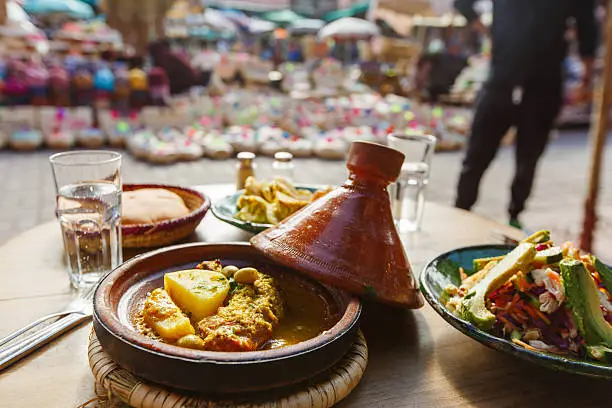
Tagine is Morocco’s most iconic dish — a slow-cooked stew prepared in a conical earthenware pot of the same name. Desert tagines typically feature chicken or lamb with preserved lemons, olives, and a blend of Ras el Hanout spices (a mixture of up to 30 spices including cumin, coriander, cinnamon, turmeric, and ginger). Vegetarian tagine variations with root vegetables and chickpeas are always available.
Moroccan mint tea (Atay n’naanaa) is the central social ritual of Berber hospitality. Prepared with Chinese gunpowder green tea, fresh spearmint, and a generous quantity of sugar, the tea is poured from height to create a light froth and served in small glasses. It is traditionally offered three times to guests — the first glass is said to be as bitter as life, the second as strong as love, and the third as sweet as death.
Other key desert foods include couscous (steamed semolina served with a vegetable or meat stew, traditionally served on Fridays), harira (a thick tomato and lentil soup with chickpeas and fresh coriander), khobz (traditional round Moroccan flatbread baked in a clay oven), and msemen (flaky layered flatbread served with argan oil and honey at breakfast).
What to Pack for a Morocco Desert Tour?
Packing correctly for a Morocco desert tour significantly affects your comfort, safety, and enjoyment — particularly during overnight stays in a desert camp. The desert environment presents two opposing challenges: extreme daytime heat requiring sun protection and breathable clothing, and cold or very cold night temperatures requiring warm layers.
| Essential Packing List — Morocco Desert Tour |
| CLOTHING: Lightweight long-sleeved shirts (linen or cotton), loose trousers, a warm fleece or down jacket for nights |
| SUN PROTECTION: Wide-brim hat or scarf/shemagh, UV400 sunglasses, sunscreen SPF 50+, lip balm with SPF |
| FOOTWEAR: Closed-toe walking shoes or trainers (sand gets inside sandals), lightweight sandals for camp |
| HEALTH: Antihistamines (dust), antibiotic diarrhoea medication, rehydration salts, blister plasters |
| GEAR: Small daypack, reusable water bottle (min 2L), headlamp + spare batteries, power bank |
| CAMERA: Extra memory cards, lens cloth (sand), camera bag with dust protection |
| DOCUMENTS: Passport, travel insurance documents, tour operator contact card |
| MONEY: Cash in Moroccan Dirhams (MAD) — ATMs are very limited in Merzouga |
What to Wear in the Morocco Desert?
The fundamental rule of desert dressing is to cover as much skin as possible during daylight hours while wearing fabrics that are light, breathable, and moisture-wicking. Exposed skin burns and dehydrates rapidly in the desert sun, and UV index levels at the Sahara regularly exceed 10 (very high) during summer and 7–9 during spring and autumn.
The recommended desert dress code for daytime: lightweight long-sleeved shirts in pale colours (white, beige, light grey) that reflect rather than absorb solar radiation; loose-fitting trousers in linen, cotton, or technical travel fabric; a wide-brim hat or a traditional Tuareg-style shemagh head wrap; UV400 sunglasses; and closed-toe walking shoes or trainers.
For desert nights, particularly between October and April, the temperature drops rapidly after sunset and can fall below 5°C (41°F) by midnight at high-altitude desert camps. A warm fleece jacket and a mid-weight down or synthetic insulated jacket are both essential for comfortable stargazing and evening camp activities.
Is the Morocco Desert Safe for Tourists?
Morocco is one of the safest countries in Africa for international tourism and consistently ranks as a low-risk travel destination by the UK Foreign, Commonwealth & Development Office (FCDO), the US Department of State, and the EU Travel Safety Advisory. The desert region of southern Morocco — including Merzouga, Zagora, M’hamid, and Ouarzazate — is among the most visited and well-established tourist corridors in the country, with a well-developed infrastructure for supporting international visitors.
The primary safety consideration for Morocco desert tours is health and heat safety rather than crime or political instability. The most common issues experienced by tourists in the desert region include: mild gastroenteritis from unfamiliar food or water (prevented by drinking only bottled water and eating at established camps and restaurants); heat exhaustion or dehydration during summer months; sunburn; and blisters or ankle sprains from dune-walking in inappropriate footwear.
| Morocco Desert Safety — Key Facts |
| 🛡️ Overall Safety: Low-risk tourism destination (FCDO / US State Dept. Level 1) |
| 🏥 Medical: Nearest hospital to Merzouga is in Errachidia (80 km); travel insurance with medical evacuation is essential |
| 🌡️ Heat Risk: Very high July–August; avoid outdoor activity between 11:00–16:00 in summer |
| 🐍 Wildlife: Saharan horned vipers and fat-tailed scorpions present; shake out footwear before wearing |
| 💧 Water: Drink bottled water only — tap water in desert towns is not reliably potable for visitors |
| 📞 Emergency Number: 190 (Police), 150 (Ambulance), 177 (Gendarmerie Royale) |
| 🧭 Guides: Always hire a licensed, government-registered guide for dune trekking beyond 5 km |
Do I Need a Visa for Morocco?
Morocco operates a largely liberal visa policy and does not require advance visas from citizens of most Western countries. Nationals of the following countries may enter Morocco visa-free for stays of up to 90 days: all EU member states, the United Kingdom, the United States of America, Canada, Australia, New Zealand, Japan, South Korea, and most Gulf Cooperation Council (GCC) states.
Citizens of countries not on the visa-free list must apply for a Moroccan tourist visa in advance through the nearest Moroccan embassy or consulate. The standard tourist visa (type “C”) allows stays of up to 90 days and must be applied for in person with a valid passport (minimum 6 months validity beyond planned departure date), a completed application form, two passport photographs, proof of accommodation booking, proof of onward travel, and proof of sufficient funds.
Important note: Morocco requires a minimum of 6 months of passport validity at the time of entry. Travellers with passports valid for less than 6 months beyond their planned departure date from Morocco will be refused boarding by airlines and entry by border officials. Check your passport validity well in advance of booking.
What Vaccinations are Required for Morocco?
No vaccinations are legally required for entry into Morocco for citizens of most countries (the exception is Yellow Fever vaccination proof, which is required only for travellers arriving from a Yellow Fever endemic country). However, several vaccinations are strongly recommended by the World Health Organisation (WHO), the US Centers for Disease Control and Prevention (CDC), and the UK NHS Travel Health service.
Recommended vaccinations for Morocco desert travel: Hepatitis A (recommended for all travellers — transmission risk from contaminated food and water is present); Typhoid (recommended — transmission via contaminated water and food); routine vaccinations kept up to date (tetanus, diphtheria, MMR, polio); Hepatitis B (recommended for longer stays or those who may require medical treatment); and Rabies pre-exposure prophylaxis (recommended for adventurous travellers in rural desert areas, as stray dogs and bats are present).
Malaria is not present in the Morocco desert region. No anti-malarial medication is required or recommended for travel to the Sahara region of Morocco.