Rabat (الرباط) is the official capital of the Kingdom of Morocco — a city that often surprises visitors with its grace, its wide boulevards, its UNESCO-listed medina, and its unhurried pace. Unlike the frenetic energy of Marrakech or the commercial hustle of Casablanca, Rabat is a city of measured elegance: tree-lined avenues, ocean-facing ramparts, and a medina that remains genuinely inhabited rather than purely tourist-facing.
Founded by the Almohad dynasty in the 12th century, Rabat has served as Morocco’s political capital since the French Protectorate established it as such in 1912. Today, with a city population of approximately 600,000 and a wider metropolitan area approaching 1.8 million, it is Morocco’s second-largest urban area and one of North Africa’s most liveable capital cities.
Rabat’s medina and historic sites were inscribed as a UNESCO World Heritage Site in 2012 under the title ‘Rabat, Modern Capital and Historic City: a Shared Heritage’.
Where is Rabat?
Rabat is located on Morocco’s Atlantic coast, at the mouth of the Bou Regreg River (وادي أبي رقراق), approximately 87 km northeast of Casablanca and 340 km west of Fes. It sits directly across the river from its twin city, Salé (سلا), connected by bridges and a modern tramway system. The city enjoys a mild Atlantic climate, with average temperatures ranging from 12°C in January to 28°C in August.
| Coordinates | 34.0209°N, 6.8416°W |
| Altitude | 75 m above sea level |
| Distance to Casa | 87 km southwest (1 hour by train) |
| Distance to Fes | 200 km east (2.5 hours by train) |
| Distance to Tangier | 345 km north (3 hours by train) |
| Climate | Mediterranean / Semi-arid Atlantic |
| Annual rainfall | ~430 mm (Oct–April) |
Must-See Attractions in Rabat
1. The Hassan Tower & Mausoleum of Mohammed V
The Hassan Tower (برج الحسن) is Rabat’s most iconic landmark — an unfinished minaret of a mosque begun in 1195 by the Almohad Sultan Yaqub al-Mansur and abandoned after his death. At 44 metres, it stands at approximately two-thirds of its intended height of 60 metres, which would have made it the world’s tallest minaret. The surrounding plaza contains the ruins of 200 columns from the abandoned mosque.
Adjacent to the tower, the Mausoleum of Mohammed V (1961–1971) is a masterpiece of modern Moroccan architecture in white Italian marble and traditional zellige tilework, housing the tombs of King Mohammed V and Kings Hassan I and Hassan II. Entry is free and respectful visitors of all faiths are welcome.
2. Kasbah of the Udayas
Built originally in the 12th century by the Almohad dynasty, the Kasbah of the Udayas (قصبة الوداية) sits at the mouth of the Bou Regreg River with sweeping views of the Atlantic and the river estuary. Its distinctive blue-and-white painted alleyways — similar to those of Chefchaouen — house a small Andalusian garden, a regional museum, and the café Maure (a classic Moroccan teahouse perched on the ramparts).
3. The Rabat Medina
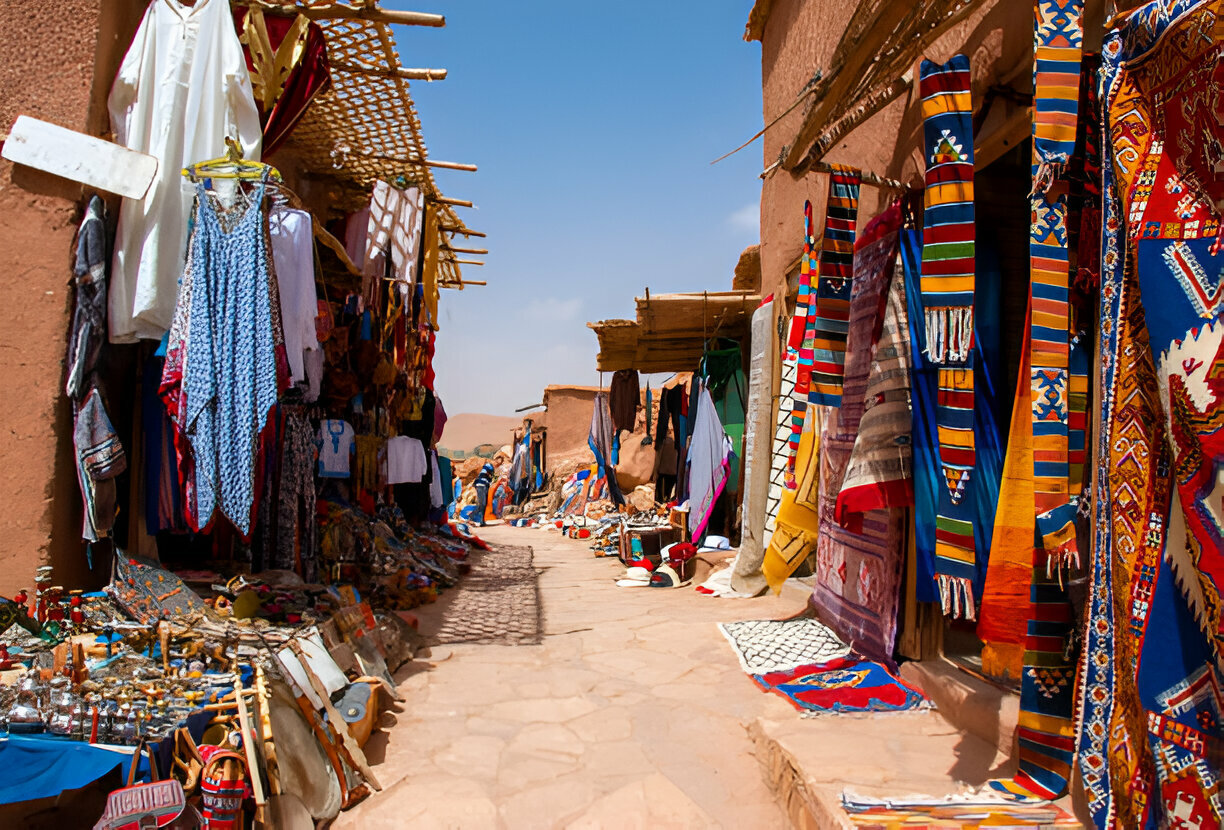
The Rabat medina is among the most accessible and least commercialised medinas in Morocco, making it an excellent alternative for visitors who find the intensity of Fes or Marrakech overwhelming. The medina’s main artery, Rue Souika and Rue des Consuls, runs from the medina gate (Bab el-Had) to the Kasbah and is lined with traditional craft workshops, textile merchants, jewellery stalls, and food vendors without the aggressive touting common elsewhere.
4. Chellah Necropolis
Chellah (شالة) is one of Morocco’s most atmospheric ancient sites — a walled Roman and Marinid necropolis dating from the 3rd century BC through the 14th century AD, now draped in bougainvillea and populated by nesting white storks. The ruins combine a Roman forum and baths with a later Marinid mosque, madrasa, and sultan’s tombs. Chellah hosts the Jazzablanca festival extension concerts each summer.
5. Mohammed VI Museum of Modern and Contemporary Art
Opened in 2014, this is Morocco’s most important modern art institution, housing an impressive permanent collection of Moroccan and Arab contemporary artists alongside rotating international exhibitions. Its architecture alone — a modernist cube clad in traditional Moroccan latticework screens — is worth the visit.
Rabat Neighbourhoods
| Medina | Historic walled city. Authentic souks, artisan workshops, local life |
| Agdal | Upscale residential & commercial district. Embassies, restaurants, cafes |
| Hassan | Central government district. Near Hassan Tower and Parliament |
| Hay Riad | Modern business district. Hotels, offices, shopping malls |
| Souissi | Wealthy residential suburb. Diplomatic residences and green spaces |
| Salé (twin city) | Across the Bou Regreg river. Traditional medina; more conservative atmosphere |
Getting to and Around Rabat
- By Train: Rabat-Ville and Rabat-Agdal stations connect to Casa (~1 hr), Fes (~2.5 hr), Marrakech (~4.5 hr) via ONCF national rail
- By Tram: The Rabat-Salé tramway (Lines 1 & 2) connects both cities and the main train stations
- By Bus: CTM and Supratours intercity coaches link Rabat to all major Moroccan cities
- By Air: Rabat–Salé Airport (RBA) — 10 km northeast; regional and European connections
- By Car: Rabat sits on Morocco’s main A1 motorway (Casablanca–Tangier)
- Within the city: Petit taxis (metered, red), Careem ride-hailing app, bicycles (Medina & riverside paths)
Where to Stay in Rabat
| Luxury | Sofitel Rabat Jardin des Roses — iconic garden hotel near the Royal Palace |
| Boutique | Dar Zitoun — elegant riad in the medina with traditional Moroccan architecture |
| Mid-range | Hôtel Balima — historic landmark on the central Boulevard Mohammed V |
| Budget | Various hostels and guesthouses in and around the medina |
Rabat Food & Cuisine
Rabat is an excellent city for Moroccan food — more authentic and affordable than Marrakech, more adventurous than Casablanca’s business dining scene. The medina’s Rue Souika is famous for its street food stalls offering harira soup, msemen (layered flatbread), brochettes, and fresh-squeezed orange juice. The neighbourhood of Agdal offers a wide range of modern cafes, French-style patisseries, and international restaurants catering to the city’s diplomatic and professional community.
- Harira — Morocco’s beloved tomato, chickpea, and lamb soup; traditionally breaks the Ramadan fast
- Pastilla — A Fassi-origin sweet-savoury pigeon or chicken pie wrapped in warqa pastry
- Grilled sardines — Fresh Atlantic sardines are a Rabat speciality, sold along the corniche
- Mint tea — The cornerstone of Moroccan hospitality, poured ceremonially from height