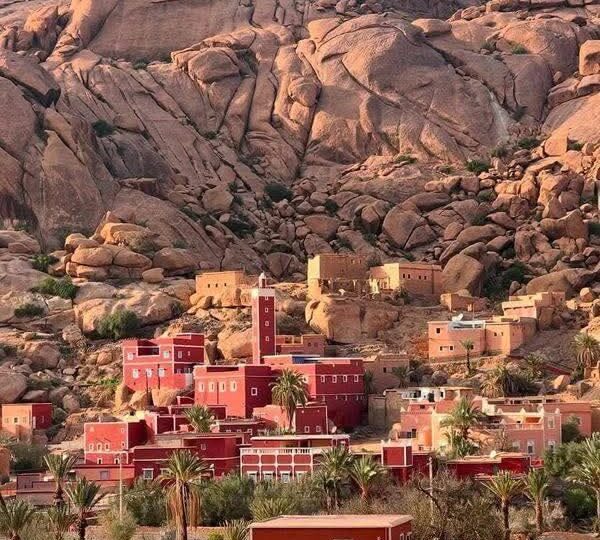
Ait Ben Haddou is one of the most extraordinary UNESCO World Heritage Sites in the world — a perfectly preserved ancient Berber fortified village built entirely from mud brick, straw, and timber, rising like a golden crown from a hillside above the Ounila River in the pre-Saharan south of Morocco. It sits 32 km northwest of Ouarzazate and is a mandatory stop on every 3-day desert tour from Marrakech.
What is Ait Ben Haddou?
Ait Ben Haddou is a ksar — a Berber word for a type of fortified communal village built to house multiple family clans within a single defensive enclosure. The ksar contains six individual kasbahs (tower houses), grain stores (agadirs), a small mosque, a Koranic school, and a network of covered alleyways and open courtyards, all enclosed within a single outer wall. The construction material throughout is pisé — a mixture of rammed earth, straw, and gypsum that is both structurally robust and naturally insulating, keeping interiors cool in summer and warm in winter.
The village has been inhabited for more than 1,000 years, serving as a key stopping point on the ancient trans-Saharan caravan route connecting Timbuktu in sub-Saharan Africa with the markets of Marrakech. Salt, gold, slaves, ivory, and spices passed through on this route. The last permanent residents moved to the modern village on the opposite bank of the river in the mid-20th century, and today a handful of Berber families maintain workshops in the old ksar selling pottery, spices, and crafts.
Films Shot at Ait Ben Haddou
The ksar’s extraordinary visual quality — its ancient towers, warm earth tones, and cinematic scale — has made it one of the most filmed locations in history:
- Gladiator (2000) — Ridley Scott’s Roman city of Zucchabar
- Game of Thrones — The slave city of Yunkai (Season 3)
- The Mummy (1999) — City of Hamunaptra
- Lawrence of Arabia (1962)
- Babel (2006) — Alejandro Gonzalez Inarritu
- Kingdom of Heaven (2005) — Ridley Scott
- Jewel of the Nile (1985)
- Hanna (2011)
- American Horror Story — Season 5
- Gladiator II (2024) — Ridley Scott’s sequel
Practical Visitor Information
Ait Ben Haddou is open year-round from approximately 8:00 AM to 6:00 PM. Entrance to the ksar involves crossing the Ounila River on stepping stones (in summer) or by footbridge (year-round). The climb to the top of the kasbah takes approximately 20–25 minutes via steep, uneven steps and packed-earth pathways. Wear closed, non-slip shoes. A local guide (available at the entrance for EUR 5–10) adds significant historical context. Photography is unrestricted throughout the site. There are several very good local restaurants near the entrance serving traditional Moroccan tagine — lunch here is one of the highlights of the desert tour.
Pro Tip: Arrive at Ait Ben Haddou before 11:00 AM or after 3:00 PM to avoid the large cruise-group tour buses that often crowd the site at midday.