Morocco desert tour from Tangier is a multi-day guided excursion that begins in Tangier — the northernmost major city in Morocco, sitting on the Strait of Gibraltar only 14 kilometers from Spain — and travels south the full length of the country to one of the country’s Sahara desert regions, primarily Merzouga (Erg Chebbi). The defining characteristic of a Tangier-departure desert tour is the total distance: 860 kilometers one-way to Merzouga, the longest desert tour origin point in Morocco. Travelers commonly miscalculate the duration required for a Tangier desert tour, assuming a 3-day round trip is feasible because that is the standard format from Marrakech; in practice, a Tangier-to-Sahara round trip requires a minimum of 6 days, and most tours run as one-way 7-to-10-day Morocco circuits ending in Marrakech rather than returning to Tangier.
Tangier desert tours are most common after one of three travel events. The first is arrival via ferry from Spain — the FRS, Inter Shipping, and Balearia ferry routes from Algeciras and Tarifa deliver thousands of passengers daily to Tangier and the nearby Tanger-Med port, and a substantial percentage of these passengers continue south for a full Morocco circuit that includes the Sahara. The second is cruise stopovers — Tanger-Med is increasingly a Mediterranean cruise port, and luxury cruise extensions occasionally include desert add-ons. The third is travelers planning a northern Morocco circuit who want to combine the blue city of Chefchaouen, the imperial cities of Fes and Meknes, and the Sahara into a single trip — a route geometry that only makes sense when starting from the north.
The standard route methodology for a Tangier desert tour follows a fixed sequence: Tangier → Chefchaouen → Volubilis or Meknes → Fes → Ifrane → Azrou → Midelt → Ziz Valley → Erfoud → Merzouga → Aït Ben Haddou → Marrakech. This is a 1,200-kilometer one-way circuit that traverses every major geographic and cultural region in Morocco, which is why Tangier desert tours, despite their length, are the most content-rich Morocco itineraries available. This guide covers the complete structure of a Tangier-departure desert tour: the definition and effects of choosing Tangier as a starting point, the 14 standard stops along the route, how tour operators define the crossing, why the distance matters, when these tours are common, how to calculate duration correctly, the round-trip versus one-way comparison, audience-specific considerations for families and solo travelers, and the planning methodology.
What is a Morocco Desert Tour from Tangier?
A Morocco desert tour from Tangier is a 6-to-10-day guided excursion that begins in Tangier and traverses the full north-to-south length of Morocco to reach the Sahara, with most tours ending one-way in Marrakech rather than returning to Tangier. The tour combines northern Morocco’s distinct cultural attractions (Chefchaouen, Volubilis, Fes), the Middle Atlas crossing (Ifrane, Azrou cedar forest), the pre-Sahara transition (Ziz Valley, Erfoud), the genuine Sahara at Merzouga (Erg Chebbi dunes), and the High Atlas / Atlantic transition (Aït Ben Haddou, Tizi n’Tichka, Marrakech). Total driving distance over the full circuit is approximately 1,200 kilometers and total tour time is 6 to 10 days depending on stops included.
What are the effects of starting a Morocco desert tour from Tangier?
Starting a Morocco desert tour from Tangier has three primary effects on the tour structure. First, it forces a multi-day commitment of at least 6 days because the Tangier-to-Sahara distance cannot be compressed into a shorter tour. Second, it produces a content-rich itinerary that includes northern Morocco regions invisible from Marrakech-departure tours — Chefchaouen, Volubilis, and the Rif Mountain region are unreachable on a 3-day Marrakech tour but are standard inclusions on a Tangier-departure circuit. Third, it almost always converts the tour from a round-trip into a one-way crossing ending in Marrakech, which means travelers must plan onward transport from Marrakech (return flight, train, or extension) rather than expecting to circle back to the original starting point. These three effects make Tangier-departure tours fundamentally different from short-format desert tours and require travelers to mentally reframe the trip from “desert tour” to “Morocco grand circuit with Sahara as one stop.”
Are there disadvantages of starting a Morocco desert tour from Tangier?
There are three disadvantages of starting a Morocco desert tour from Tangier. The first is the minimum duration commitment — travelers cannot complete a Tangier-departure desert tour in less than 6 days, which excludes short-trip travelers. The second is the per-day cost — Tangier-departure tours cost between $400 and $2,500+ per person, with the lower end significantly higher than the equivalent 3-day Marrakech tour at $90, because the longer duration requires more accommodations, meals, and vehicle hours. The third is the operator constraint — Tangier has fewer ONMT-licensed desert tour operators than Marrakech or Fes, which means traveler choice is narrower and prices are less competitive. These disadvantages are real but are offset by the depth of content delivered: a Tangier-departure tour is closer to a Morocco grand tour than to a desert excursion, and travelers who want both should expect Tangier to be the optimal starting point.
What are the Stops on a Morocco Desert Tour from Tangier?
The standard stops on a Morocco desert tour from Tangier are listed below.
1. Tangier
Tangier is the departure point and the only true “international gateway” north of Casablanca. The city sits on the Strait of Gibraltar at the meeting point of the Atlantic and Mediterranean, and it has been a continuous trading port for over 2,500 years. The city’s medina is small and walkable in a single morning, and the cultural attractions include the Kasbah Museum (former sultan’s palace), the Caves of Hercules, and Cap Spartel (the northwesternmost point of mainland Africa). Tangier International Airport (TNG) handles flights from Madrid, Paris, Brussels, and several other European cities; Tanger-Med port handles ferry traffic from Algeciras and Tarifa.
2. Chefchaouen
Chefchaouen — known as “the blue city” — is a small mountain town in the Rif Mountains located 115 kilometers and 2 hours southeast of Tangier. The medina is famous for its blue-painted walls and stairways, a tradition with multiple disputed origins (mosquito repellent, Jewish heritage, water symbolism). Chefchaouen is the most photographed small town in Morocco and is included on virtually every Tangier-departure desert tour. The standard visit duration is one full afternoon and one overnight, with travelers typically using the time for medina photography and a viewpoint hike to the Spanish Mosque overlooking the city.
3. Volubilis
Volubilis is the most extensive Roman archaeological site in Morocco, located approximately 30 kilometers north of Meknes and an easy detour from the Tangier-to-Fes route. The site contains substantial mosaic floors, a triumphal arch, a basilica, and the partially-preserved walls of a 1st-century Roman city. UNESCO listed Volubilis as a World Heritage site in 1997. Standard visit duration is 1 to 2 hours and the site is typically combined with a half-day in nearby Meknes.
4. Meknes
Meknes is one of Morocco’s four imperial cities (along with Marrakech, Fes, and Rabat) and was the capital under Moulay Ismaïl in the late 17th century. The city is smaller and quieter than Fes, with the monumental Bab Mansour gate, the Mausoleum of Moulay Ismaïl, and the ruined royal palace as the main attractions. Standard visit duration on a Tangier circuit is a half-day, often combined with Volubilis as a single excursion.
5. Fes
Fes is Morocco’s cultural and spiritual capital and home to the world’s oldest continuously operating university, Al-Qarawiyyin (founded 859 AD). The Fes el-Bali medina is the largest car-free urban area in the world and is a UNESCO World Heritage site. Standard visit duration on a Tangier circuit is a full day or two, including the medina walking tour with a licensed guide (essential — the medina has 9,000+ alleys and is genuinely impossible to navigate without help), the Chouara Tannery, and the Bou Inania Madrasa.
6. Ifrane
Ifrane is a Middle Atlas town at 1,665 meters elevation, often called “Morocco’s Switzerland” because of its alpine-style architecture (red-tiled roofs, half-timbered buildings) developed during the French Protectorate as a summer retreat. The town is small and most tours stop only briefly for photographs and coffee — Al Akhawayn University (Morocco’s main English-language university) is the most notable feature.
7. Azrou Cedar Forest
The Azrou cedar forest is one of the largest cedar forests in North Africa and home to a wild population of Barbary macaques — the only macaque species native to Africa and a critically endangered species. Most Tangier-departure tours stop in the cedar forest for 20 to 30 minutes to observe the macaques. The recommended approach is to view the monkeys from a distance and avoid feeding them, which is technically illegal and contributes to the species’ habituation problems. Some tour operators stop only briefly because of the touts who sell peanuts to feed the monkeys; ethical operators avoid this.
8. Midelt
Midelt is a small market town in the High Plateaus between the Middle and High Atlas, known for apple orchards, mineral mines, and a Berber carpet weaving tradition. Most tours stop for lunch at a tour-affiliated restaurant — typical fare includes tagine, couscous, or grilled meat. The standard stop duration is 1 hour.
9. Ziz Valley
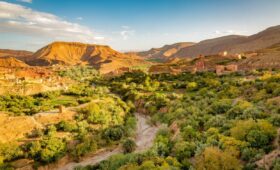
The Ziz Valley is a dramatic palm-oasis canyon that the road follows for approximately 50 kilometers between Midelt and Erfoud. The Ziz River runs through the bottom of the valley and the palmeraie (palm grove) extends for kilometers in both directions. There are scheduled photo viewpoints along the road, and most tours stop for 15 to 20 minutes at the main viewpoint above the upper Ziz.
10. Erfoud
Erfoud is the gateway town to the Sahara at the eastern edge of the Tafilalet Oasis. The town is famous for its fossil-preparation industry — the surrounding hills contain extensive Devonian-period marine fossils that are extracted, polished, and sold both locally and internationally. Most tours stop briefly at a fossil workshop for travelers who want to purchase fossil specimens. The standard stop duration is 30 to 45 minutes.
11. Merzouga
Merzouga is the small village at the western edge of Erg Chebbi and the launch point for the camel trek into the dunes. The village itself has hotels, restaurants, and small shops, but the true destination is the dunes themselves, which begin immediately east of the village. Most tours arrive in Merzouga in mid-afternoon, take a brief rest at a hotel, and begin the sunset camel trek to the desert camp.
12. Erg Chebbi Dunes
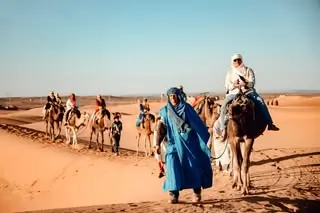
Erg Chebbi is the largest sand sea in Morocco and the destination of the Tangier-departure desert tour. The dunes stretch 22 kilometers north-to-south and reach 150 meters in height. The Tangier-departure tour typically includes one full overnight at a camp in the dunes, with sunset and sunrise viewings, a Berber dinner, drum music around the campfire, and stargazing. Some Tangier tours include a second night at the camp, which significantly improves the desert experience.
13. Aït Ben Haddou
Aït Ben Haddou is a UNESCO World Heritage kasbah located between Ouarzazate and Marrakech on the return leg of the Tangier circuit. The kasbah has appeared in Gladiator, Game of Thrones, The Mummy, and several other major productions. Standard visit duration is 1 to 1.5 hours, including a guided walk through the kasbah and lunch at a nearby restaurant.
14. Marrakech (Typical End Point)
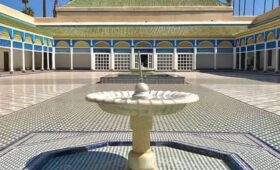
Marrakech is the standard end point for a Tangier-departure desert tour. The city itself is the imperial capital of southern Morocco and has its own substantial tourist offerings — Jemaa el-Fnaa square, the Bahia Palace, the Majorelle Garden, the Saadian Tombs, and the Koutoubia Mosque. Most Tangier-departure tours arrive in Marrakech on Day 7 or Day 8 and either end the tour there (with travelers continuing independently) or include 1 to 2 additional days of guided Marrakech exploration before the official tour conclusion.
How do tour operators define a Tangier-to-Sahara crossing?
Tour operators and major travel guidebooks define a Tangier-to-Sahara crossing as a multi-region one-way circuit rather than as a “desert tour” in the conventional Marrakech sense. The Lonely Planet Morocco guide structures its Tangier-region itineraries around a 7-to-10-day southbound circuit that explicitly treats the Sahara as one of multiple destinations rather than the singular goal. The Rough Guide to Morocco similarly groups Tangier-departure routes as “Morocco overland circuits” and emphasizes that the desert leg is geographically and operationally inseparable from the northern Morocco content. Morocco’s national tourism office (ONMT) publishes route recommendations that align with this categorization — Tangier is positioned as a starting point for a “Grand Tour of Morocco” rather than for a desert excursion. This definitional difference matters for travelers because the booking, pricing, and pacing of a Tangier-departure tour follow grand-tour conventions rather than desert-tour conventions.
Why is the long distance from Tangier significant for desert tour planning?
The long distance from Tangier is significant for desert tour planning because it forces every other planning variable to adapt. A Tangier-to-Merzouga one-way trip is 860 kilometers and takes approximately 14 hours of pure driving — comparable to driving from London to Edinburgh. Adding the Marrakech return leg (560 kilometers, 10 hours), the total round trip is 1,420 kilometers and 24 hours of driving. These distances cannot be compressed: speed limits on Moroccan roads are 100 km/h on highways and 60-80 km/h on rural routes, and the Atlas crossings require slower speeds on switchbacks. Distance forces a minimum 6-day round trip, which forces a higher total cost, which forces a different traveler profile (longer-stay travelers rather than short-trip vacationers), which forces operators to design products as grand tours rather than desert-only tours. Every component of a Tangier-departure tour is downstream of the distance constant.
When are Tangier desert tours common?
Tangier desert tours are common during specific travel patterns and traveler types rather than during specific seasons. The two dominant patterns are described below.
1. Ferry Passengers from Algeciras and Tarifa (Spain)
Ferry passengers from Algeciras and Tarifa account for a substantial share of Tangier-departure desert tour bookings. The Algeciras-Tanger Med route is the busiest ferry route between Spain and Morocco, with multiple daily departures operated by FRS, Balearia, and Inter Shipping; the journey takes approximately 90 minutes. The Tarifa-Tangier route is the shortest, at 35 minutes, and lands directly at Tangier’s central port. Ferry passengers are typically self-driving Europeans on extended trips (often spending 2 to 4 weeks in Morocco) or backpackers connecting from Spain after Andalusia. These travelers are predisposed to longer Morocco circuits because they have already committed to the longer overland format by choosing the ferry route over a direct flight to Marrakech.
2. Northern Morocco Circuit Travelers
Northern Morocco circuit travelers are the second major source of Tangier-departure desert tour bookings. These are travelers — often arriving by direct flight to Tangier International (TNG) or via the Tarifa ferry — who specifically want to combine the northern attractions (Chefchaouen, Volubilis, Fes, Meknes) with the Sahara into a single trip. The northern-circuit-plus-Sahara combination is approximately 7 to 10 days and produces what most experienced Morocco visitors consider the most varied and content-rich Morocco itinerary available. Real-world scenarios include honeymooners who want to combine Chefchaouen’s Instagram-photogenic blue medina with the Sahara’s iconic dunes, photographers who want to capture Morocco’s geographic and cultural range in a single trip, and group tour operators who design their highest-priced Morocco products specifically around this circuit.
How to calculate the correct duration for a Tangier desert tour?
The correct duration for a Tangier desert tour is calculated by adding the required stops and driving days. The base formula is: 1 day Tangier + 1 day Chefchaouen + 1 day Volubilis/Meknes + 1 to 2 days Fes + 1 day Atlas crossing + 1 to 2 days Sahara + 1 day return to Marrakech via Aït Ben Haddou + 1 day Marrakech = 8 to 10 days minimum. Travelers who attempt to compress this circuit below 7 days inevitably skip either Chefchaouen or Volubilis, which defeats the purpose of starting from Tangier in the first place. The recommended minimum duration for a meaningful Tangier-departure desert tour is 7 days; the comfortable duration is 9 to 10 days; and the leisurely duration is 12 days, which adds extra time at major stops and an Atlantic coast extension to Essaouira.
What is the opposite of a Tangier round-trip desert tour?
The opposite of a Tangier round-trip desert tour is a one-way Tangier-to-Marrakech crossing — and the opposite is what almost all travelers should choose. A round-trip from Tangier requires the traveler to drive the same circuit twice (once southbound to the desert, once northbound back to Tangier), which adds approximately 4 to 5 driving days to the total tour without adding any new content. A one-way Tangier-to-Marrakech crossing covers the same northern Morocco content and the same Sahara content but ends in Marrakech, freeing the traveler to either fly home from Marrakech (RAK has direct flights to most European hubs) or extend the trip with a coastal extension. The cost difference is also meaningful — one-way tours typically cost 30 to 40 percent less than round-trip equivalents because the operator does not have to fund the return-leg vehicle and driver days. Travelers who specifically need to return to Tangier (for a return ferry to Spain or a flight from TNG, for example) should still consider one-way to Marrakech and use the Al Boraq high-speed train (4 hours, ~$60) or a domestic flight (1 hour, ~$80) to return north on the final day.
Can families take a Tangier-departure desert tour?
Yes, families can take a Tangier-departure desert tour, but with two important adjustments. First, the duration must be longer rather than shorter — a 9-to-10-day tour is significantly more comfortable for children than a compressed 7-day version, because the longer tour allows full rest days at major stops (Chefchaouen and Fes especially) rather than constant driving. Second, the itinerary should include child-friendly stops: the Azrou cedar forest macaque viewing is particularly appealing to children, and the Aït Ben Haddou kasbah doubles as a “real-life movie set” experience that children connect to visually. Most family operators recommend ages 6+ for the camel trek and ages 4+ for the camp itself, the same minimums as on any Morocco desert tour. Tangier-departure family tours typically cost more per person than equivalent Marrakech tours because of the longer duration, and families of three or more should specifically request private tour pricing for cost efficiency.
Can solo travelers do Tangier desert tours?
Yes, solo travelers can do Tangier desert tours, and the longer-format Tangier-departure circuit is particularly well-suited to solo travelers who want depth over breadth. Solo travelers benefit from group tours on the Tangier-departure format because the 9-to-10-day duration creates a meaningful traveling community within the group — most solo travelers who book Tangier-departure tours report forming friendships that continue beyond the tour itself. The single supplement on private tours is high (typically 50 to 80 percent of the per-person rate), so solo travelers who want privacy should expect to pay $1,500 to $3,000+ for a private Tangier circuit, while solo travelers willing to share are well-served by group products at $400 to $900. Female solo travelers report Tangier-departure circuits as comfortable, with the qualifier that the extended urban time in Tangier and Fes carries the same medina-area considerations that apply to any Morocco trip.
How to plan a Tangier-departure desert tour?
Planning a Tangier-departure desert tour follows a six-step process.
- Decide one-way to Marrakech vs round-trip — One-way is recommended for almost all travelers; round-trip only when a Tangier ferry or TNG flight return is required.
- Pick the duration — 7 days minimum, 9-10 days recommended, 12+ days for a leisurely pace with coastal extension.
- Choose the tour type — Group, private, or luxury based on traveler profile and budget. Cruise stopover variants exist but only deliver Marrakech day trips, not the genuine Sahara.
- Verify the operator — ONMT licensing, TripAdvisor or Google rating of 4.5+ stars with 100+ reviews, transparent pricing, English-speaking guides where requested.
- Confirm inclusions in writing — Vehicle type, accommodation tier per stop, meal count, camp name, transfers between cities, end-of-tour drop-off location.
- Pay the deposit — Reputable Tangier-departure operators take 20–30% as deposit, with the balance paid in cash or card at tour start.
The single most important planning decision is duration. Travelers who attempt a Tangier-to-Sahara round trip in less than 6 days inevitably regret the compression; travelers who allow 9 to 10 days find the format produces the most varied Morocco experience available.
Final Thoughts
Morocco desert tour from Tangier is not a “desert tour” in the conventional Marrakech-departure sense — it is a Morocco grand circuit with the Sahara as one of multiple major destinations. The geometry of starting in the far north forces a longer commitment, a higher cost, and a content-richer itinerary, all of which combine into one of the most rewarding travel formats Morocco offers. Travelers who arrive via ferry from Spain, who specifically want to combine the northern attractions (Chefchaouen, Volubilis, Fes) with the Sahara, or who have 7+ days available and want the deepest possible Morocco experience should choose Tangier as the starting point. Travelers without those specific constraints — particularly those with shorter trips or budget priorities — should default to Marrakech departures and treat Tangier as a separate, independent visit. The Tangier-departure tour is the longest and most expensive Morocco desert tour format, and it is also the most content-dense; the trade-off is real and well-defined, and the right choice depends entirely on traveler profile and time available.