The Kingdom of Morocco (officially Al-Mamlaka al-Maghribiya in Arabic), a constitutional monarchy led by King Mohammed VI, is a sovereign nation located in the northwestern corner of the African continent, strategically positioned where Africa meets Europe across the narrow Strait of Gibraltar. Bordered to the east and southeast by Algeria, to the south by the disputed territory of Western Sahara, to the north by the Mediterranean Sea, and to the west by the Atlantic Ocean, Morocco occupies a total area of approximately 446,300 km² and is home to a population of around 37 million people, making it one of the most populous nations in North Africa. Its official capital is Rabat, the seat of government, parliament, and diplomatic life, while its largest and most economically significant city is Casablanca — together forming the twin pillars of the country’s political and commercial identity.
🇲🇦 Morocco at a Glance
| Official Name | Kingdom of Morocco (Al-Mamlaka al-Maghribiya) |
| Capital | Rabat |
| Largest City | Casablanca |
| Continent | Africa (Northwest — bordering Europe) |
| Population | ~37 million (2024) |
| Area | 446,300 km² |
| Official Languages | Arabic & Tamazight (Berber) |
| Other Languages | French (widely used), Spanish (north), Darija |
| Religion | Islam (official and predominant, ~99%) |
| Currency | Moroccan Dirham (MAD — د.م.) |
| Country Code | +212 |
| Internet Extension | .ma |
| Time Zone | WET UTC+0 / WEST UTC+1 (summer) |
| Government | Constitutional Monarchy — King Mohammed VI |
| GDP | ~$142 billion USD |
Where is Morocco?
Morocco is located in the northwestern corner of Africa, commonly referred to as the Maghreb region. It is one of the few African countries that has coastlines on two major bodies of water: the Atlantic Ocean to the west and the Mediterranean Sea to the north. This unique dual-coastal position has made Morocco a historic crossroads between Africa, Europe, and the Arab world for thousands of years.
To the north, Morocco is separated from Spain by the Strait of Gibraltar — a narrow stretch of water just 14 kilometres (8.7 miles) wide at its narrowest point. This proximity to Europe has profoundly shaped Morocco’s culture, economy, and linguistic landscape. To the east and southeast, Morocco shares its border with Algeria, though that border has been officially closed since 1994. To the south lies the disputed territory of Western Sahara, which Morocco has administered since 1975.
Morocco is the only African country with a coast on both the Atlantic Ocean and the Mediterranean Sea — a geographic advantage that has driven trade and cultural exchange for millennia.
What Continent Is Morocco In?
Morocco is located on the African continent, specifically in North Africa. It is a founding member of the Arab Maghreb Union alongside Algeria, Tunisia, Libya, and Mauritania. Despite being geographically in Africa, Morocco shares many cultural, architectural, and economic ties with Southern Europe and the Arab world, which gives it a uniquely cosmopolitan character.
Geopolitically, Morocco is also an observer state of the Economic Community of West African States (ECOWAS) and maintains strong bilateral relations with both the African Union and the European Union, reflecting its dual identity as an African and Mediterranean nation.
What is Morocco’s Population?
As of 2024, Morocco has a population of approximately 37 million people, making it the fifth most populous country in Africa. The population growth rate stands at around 1.2% per year, reflecting a gradual demographic transition from high to moderate fertility rates observed over the past two decades.
Morocco is increasingly urbanised: approximately 65% of the population lives in cities, with rural communities concentrated in the Atlas Mountain regions and the agricultural plains. The median age is around 30 years, making Morocco a relatively young country with a significant youth demographic that drives both its labour market and its consumer economy.
- Urban population: ~65% — concentrated in Casablanca, Rabat, Fes, and Marrakech
- Rural population: ~35% — primarily in the Atlas, Rif, and Souss-Massa regions
- Population density: 83 people per km²
- Diaspora: Over 5 million Moroccans live abroad (France, Spain, Italy, Belgium, Netherlands)
What are Morocco’s Coordinates?
Morocco is situated between latitudes 27°N and 36°N, and longitudes 1°W and 14°W. Its geographic centre is approximately at 32°N, 5°W. The country extends roughly 1,800 km from north to south and spans about 780 km from east to west at its widest point.
Northern tip: Tangier Peninsula (35.9°N) — one of the closest points to mainland Europe in Africa
Southern boundary: Western Sahara border region (~27.7°N)
Westernmost point: Cape Spartel (5.9°W), where the Atlantic meets the Mediterranean
What is Morocco’s Time Zone?
Morocco operates on Western European Time (WET), which is UTC+0 in winter. During summer months, Morocco observes Western European Summer Time (WEST), which is UTC+1. However, Morocco’s approach to daylight saving time has been irregular in recent years — it suspended daylight saving time in 2019 and made UTC+1 (WEST) its permanent standard time year-round, only reverting to UTC+0 during the month of Ramadan.
This means that Morocco is effectively 1 hour ahead of the UK during standard time, in the same time zone as France and Spain, and 5 to 6 hours ahead of the US Eastern Time Zone.
What is the Time Difference Between Morocco and Other Countries?
| Morocco vs United Kingdom | Same time (UTC+1 Morocco, UTC+0 UK) — Morocco is +1h in winter |
| Morocco vs France / Spain | Same time zone (UTC+1) — no difference |
| Morocco vs USA (East Coast) | Morocco is 5 hours ahead (EST) / 6 hours (EDT) |
| Morocco vs UAE (Dubai) | Morocco is 3 hours behind (Gulf Standard Time UTC+4) |
| Morocco vs Saudi Arabia | Morocco is 2 hours behind (AST UTC+3) |
| Morocco vs Japan | Morocco is 8 hours behind (JST UTC+9) |
What is the Official Language of Morocco?
Morocco has two official languages: Modern Standard Arabic (العربية الفصحى) and Tamazight — the Berber language family spoken natively by the indigenous Amazigh (Berber) people of North Africa. Tamazight was granted official language status alongside Arabic in the 2011 constitutional reform, a landmark recognition of Morocco’s indigenous heritage.
In practice, everyday communication in Morocco relies heavily on Darija, a distinctive Moroccan dialect of Arabic that blends Arabic, Tamazight, French, and Spanish influences. Darija differs significantly from Modern Standard Arabic and is largely unintelligible to speakers from the Middle East.
What are the Languages Spoken in Morocco?
- Modern Standard Arabic — official, used in government, media, education
- Tamazight (Berber) — official, spoken by 25–30% of the population; includes Tachelhit, Tarifit, and Central Atlas Tamazight dialects
- Darija (Moroccan Arabic) — the primary spoken vernacular for ~90% of Moroccans
- French — used in business, higher education, international diplomacy; spoken fluently by ~33% of the population
- Spanish — widely spoken in northern Morocco (Tangier, Tetouan, Al Hoceima) due to historical Spanish protectorate influence
- English — growing rapidly, especially among the youth and in the tourism and tech sectors
What is Morocco’s Telephone and Country Code?
International Dialing Code: +212
To call Morocco from abroad, dial your country’s exit code (e.g., 00 or +), followed by 212, then the local number omitting the leading 0. For example, to call a Moroccan mobile number 06XXXXXXXX, you would dial +212 6XXXXXXXX.
Morocco’s telecommunications infrastructure is managed by three main operators: Maroc Telecom (Itissalat Al-Maghrib), Orange Morocco, and Inwi. Mobile penetration exceeds 130%, and 4G coverage reaches over 90% of the populated territory. The country has been rapidly expanding its fibre-optic broadband network as part of its national digital transformation strategy.
What is the Moroccan Flag?
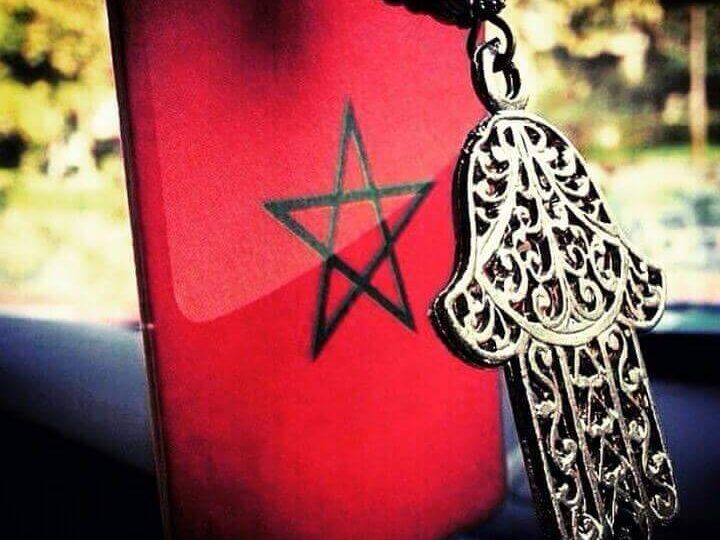
The flag of Morocco consists of a red background with a green pentacle (five-pointed star) in its centre. The red colour has been associated with the Moroccan royal dynasties and is historically linked to the Alaouite dynasty, which has ruled Morocco since the 17th century. The green pentacle, known as the Seal of Solomon (خاتم سليمان), represents the five pillars of Islam and the nation’s links to the Islamic faith.
The current flag design was officially adopted in November 1915, during the French Protectorate period, to distinguish Morocco’s banner from the plain red flags used by other states at the time. The star was previously solid green and was outlined in its present form in 1915.
The Moroccan flag is one of the oldest continuously used national flags in the world, with red banners flying over Moroccan kingdoms for over three centuries.
What is Morocco’s Internet Extension?
Morocco’s official country-code top-level domain (ccTLD) is .ma — derived from ‘Maroc’, the French name for Morocco. The .ma domain is administered by ANRT (Agence Nationale de Réglementation des Télécommunications), Morocco’s national telecommunications regulatory authority.
Registration of a .ma domain requires the registrant to have a legal connection to Morocco (individuals or organisations based in Morocco). Businesses and institutions in Morocco use .ma to establish their local online identity, while the broader Moroccan web ecosystem also makes significant use of global domains (.com, .org) particularly for internationally targeted content.
What Is The Capital Of Morocco?
The capital of Morocco is Rabat (الرباط), a city of approximately 600,000 inhabitants situated on the Atlantic coast at the mouth of the Bou Regreg River. Rabat has served as the political and administrative capital of Morocco since 1912, when the French Protectorate transferred this function from the imperial city of Fes.
It is important to note that Rabat is not Morocco’s largest or most economically significant city — that distinction belongs to Casablanca (الدار البيضاء), which functions as the country’s commercial and financial hub with over 4 million inhabitants in its greater metropolitan area. Rabat, by contrast, is the seat of government, home to the Royal Palace, the Parliament, and all major ministries and foreign embassies.
Rabat’s medina and the Hassan Tower are UNESCO World Heritage Sites, making the capital one of Morocco’s four imperial cities alongside Fes, Marrakech, and Meknes.
What Are Morocco’s Cities?
Morocco is home to four historic ‘Imperial Cities’ — royal capitals from different dynasties — alongside a growing network of modern coastal and industrial metropolises. Here are Morocco’s most significant cities:
| Casablanca | Largest city & economic capital. Population: ~4.3M metro. Morocco’s main port and financial centre. |
| Rabat | National capital. Population: ~600K city / ~1.8M metro. Seat of government & diplomacy. |
| Fes (Fez) | Imperial city & cultural capital. Population: ~1.2M. Home to the world’s oldest university (Al-Qarawiyyin, 859 AD). |
| Marrakech | Imperial city & tourism capital. Population: ~1M. Morocco’s most visited destination. |
| Tangier | Northern gateway. Population: ~800K. Major port linking Africa to Europe via ferry. |
| Agadir | Southern resort city. Population: ~600K. Morocco’s leading beach tourism destination. |
| Meknes | Imperial city. Population: ~700K. Known for its monumental Bab Mansour gate. |
| Oujda | Eastern city near Algeria. Population: ~500K. University and commercial hub. |
| Essaouira | Atlantic coastal city. Known for its medina, wind sports, and arts scene. |
| Chefchaouen | The ‘Blue City’ in the Rif Mountains. Famous for blue-painted streets. |
What are the Places to Visit in Morocco?
Morocco is one of Africa’s premier travel destinations, attracting over 14 million international visitors per year. Its appeal lies in an extraordinary combination of ancient medinas, Saharan landscapes, Atlantic and Mediterranean beaches, Berber mountain villages, and vibrant souks. Below are the top destinations that every visitor to Morocco should consider:
- Marrakech — The ‘Red City’: Jemaa el-Fna square, Bahia Palace, Majorelle Garden, Koutoubia Mosque, and the endless souks of the medina
- Fes el-Bali — The world’s largest car-free urban area and a UNESCO World Heritage Site. Home to the Chouara Tanneries and the Bou Inania Madrasa
- Sahara Desert (Erg Chebbi & Merzouga) — Morocco’s iconic golden sand dunes in the southeast. Camel treks and overnight desert camps
- Chefchaouen — The magical blue-washed mountain town in the Rif Mountains, beloved by photographers and travellers alike
- Essaouira — A charming walled Atlantic port city with a UNESCO-listed medina, world-class windsurfing, and a thriving arts scene
- Atlas Mountains — Trekking, Berber villages, and the highest peak in North Africa: Jebel Toubkal (4,167 m)
- Ait Benhaddou — A spectacular UNESCO-listed ksar (fortified village) frequently used as a backdrop for Hollywood films
- Rabat — The understated capital, with its Kasbah of the Udayas, Hassan Tower, and the vast Mausoleum of Mohammed V
- Tangier — Reinvented as a cultural hub, with the Kasbah Museum, Cape Spartel lighthouse, and panoramic Strait of Gibraltar views
- Agadir & Souss Valley — Beach resorts, the Souss-Massa National Park, and the argan oil heartland
Morocco is home to 9 UNESCO World Heritage Sites including the medinas of Fes, Marrakech, Essaouira, and Meknes, the Ksar of Ait-Ben-Haddou, and the Portuguese City of Mazagan (El Jadida).
What is the Area of Morocco?
Morocco has a total recognised land area of approximately 446,300 km² (172,317 square miles), making it the 57th largest country in the world and roughly the size of the state of California or the combined area of Germany and Austria. Its territory stretches from the Mediterranean coast in the north to the edge of the Sahara Desert in the south, and from the Atlantic seaboard in the west to the Algerian border in the east.
Morocco also administers the disputed territory of Western Sahara — a former Spanish colony of 266,000 km² — which, if included, would bring Morocco’s total controlled area to approximately 712,550 km². This territorial dispute remains unresolved under international law, with the Sahrawi Polisario Front advocating for independence backed by Algeria.
How is the Moroccan Economy?
Morocco has one of the most diversified and stable economies in Africa, consistently ranking among the continent’s top five economies. It operates as a mixed economy with a strong private sector, a large agriculture base, a dynamic tourism industry, and growing technology and renewable energy sectors. The World Bank classifies Morocco as a lower-middle-income country with ambitions to achieve upper-middle-income status by 2035.
Key sectors driving the Moroccan economy include phosphate mining (Morocco holds over 70% of the world’s known phosphate reserves through OCP Group, the world’s largest phosphate exporter), tourism (14+ million arrivals, pre-COVID), automotive manufacturing (Renault and Stellantis have major plants in Tangier and Kenitra), and agriculture (employing approximately 40% of the workforce).
Morocco is the world’s largest exporter of phosphate rock and phosphate-based fertilisers — a strategic resource that underpins global food security and gives Morocco significant geopolitical leverage.
What is Morocco’s Per Capita National Income?
Morocco’s Gross National Income (GNI) per capita using the Atlas method stands at approximately $3,700 USD (2023), placing it in the lower-middle-income category by World Bank standards. Adjusted for purchasing power parity (PPP), the figure rises to approximately $9,000 international dollars, reflecting that the cost of living in Morocco is significantly lower than in high-income countries.
Morocco ranks approximately 4th or 5th in Africa by GNI per capita among larger economies, behind South Africa, Egypt (on a PPP basis), and Tunisia. Within the Arab world, it ranks below the Gulf states but is broadly comparable to Egypt and Jordan in terms of real purchasing power.
What is Morocco’s Currency?
Morocco’s official currency is the Moroccan Dirham (MAD), symbolised as د.م. or simply DH. The dirham is subdivided into 100 centimes. The Bank Al-Maghrib (Morocco’s central bank) issues and regulates the currency, which operates under a managed float regime — meaning its exchange rate is pegged within a band against a basket of currencies (primarily the Euro and the US Dollar).
Approximate exchange rates (2024): 1 USD ≈ 10.0 MAD | 1 EUR ≈ 10.8 MAD | 1 GBP ≈ 12.6 MAD
Morocco maintains strict capital controls, meaning the dirham is not freely convertible outside the country. Visitors must exchange currency at official banks, exchange bureaus (bureaux de change), or ATMs within Morocco. It is illegal to import or export dirhams in significant quantities.
What is Morocco’s GDP?
Morocco’s nominal GDP stands at approximately $142 billion USD (2023), making it the 5th largest economy in Africa by nominal GDP, behind Nigeria, South Africa, Egypt, and Algeria. When adjusted for purchasing power parity (PPP), Morocco’s GDP rises to approximately $330 billion international dollars.
The Moroccan economy grew at a rate of approximately 3.4% in 2023, recovering steadily from the twin shocks of COVID-19 and the devastating September 2023 earthquake centred near Marrakech that killed over 2,900 people and caused significant infrastructure damage in the High Atlas region.
- Services sector: ~55% of GDP (tourism, finance, retail, telecom)
- Industry sector: ~28% of GDP (phosphates, automotive, textiles, construction)
- Agriculture sector: ~11% of GDP (employs ~40% of the labour force)
Where Does Morocco Rank in the Human Development Index?
Morocco ranks 123rd out of 193 countries in the 2023 UNDP Human Development Index (HDI), with a score of 0.698 — placing it in the ‘medium human development’ category. This positions Morocco in the upper-middle tier of African nations for human development, above the sub-Saharan African average but below the most developed Arab and North African states such as Algeria, Tunisia, and Libya.
Morocco has made significant progress over the past two decades in education access, health outcomes, and poverty reduction. The adult literacy rate stands at approximately 75% (with notable gender and urban/rural disparities), life expectancy at birth is approximately 77 years, and the proportion of the population living below the national poverty line has fallen from over 15% in 2000 to below 5% today.
What Ranks Morocco in Happiness?
In the 2023 World Happiness Report, Morocco ranked 92nd globally out of 137 countries, with a score of 5.231 on the Cantril ladder scale. While this places Morocco in the mid-range globally, it ranks as one of the happier countries in North Africa and the Arab world when cultural context is considered.
Key factors influencing Morocco’s happiness ranking include strong family and community bonds (one of the highest-scoring dimensions), strong religious identity providing social cohesion, and growing economic opportunities in urban centres. Areas pulling the score lower include income inequality, rural poverty, and youth unemployment, which remains stubbornly high at around 30% nationally.
How is the Moroccan Army?
The Royal Moroccan Armed Forces (القوات المسلحة الملكية المغربية) constitute Morocco’s military establishment, under the supreme command of King Mohammed VI as Commander-in-Chief. The Armed Forces are among the most capable and well-equipped on the African continent, with a history stretching back centuries through the various Moroccan sultanic dynasties.
- Total active personnel: approximately 200,000 (Royal Army: ~175,000; Navy: ~13,000; Air Force: ~13,000)
- Reserve forces: approximately 150,000 personnel
- Defence budget: approximately $5.4 billion USD (2023) — one of the highest in Africa
- Royal Gendarmerie: a separate paramilitary force of ~25,000 responsible for rural security
- Major operations: Moroccan forces have historically participated in UN peacekeeping missions across Africa and the Middle East
Morocco has been modernising its military equipment substantially, acquiring F-16 fighter jets from the United States, acquiring drones (including Israeli Hermes and Harop systems), and receiving significant military aid under its strategic partnership with the US (Morocco is a Major Non-NATO Ally).
What is Morocco’s Policy?
Morocco is a constitutional monarchy governed under the 2011 constitution, which significantly expanded the powers of the elected parliament and prime minister while retaining the King’s role as the supreme political authority, Commander of the Faithful (Amir al-Muminin), and head of state. King Mohammed VI, who has reigned since 1999, plays a central role in shaping both domestic and foreign policy.
The parliament is bicameral, consisting of the House of Representatives (lower house, 395 seats) and the House of Councillors (upper house, 120 seats). The Prime Minister — officially titled Head of Government — is appointed from the party winning the largest number of parliamentary seats. Morocco held general elections in 2021, in which the National Rally of Independents (RNI) won the most seats, with Aziz Akhannouch becoming Head of Government.
- Foreign policy priority 1: Deep integration with the European Union (Association Agreement, Advanced Status partnership)
- Foreign policy priority 2: Pan-African leadership — Morocco rejoined the African Union in 2017 and has invested heavily across sub-Saharan Africa
- Foreign policy priority 3: Strategic partnership with the United States (Major Non-NATO Ally status since 2004)
- Foreign policy priority 4: Abraham Accords — Morocco normalised relations with Israel in December 2020 in exchange for US recognition of Moroccan sovereignty over Western Sahara
- Key domestic policy: ‘New Development Model’ (NMD) — a comprehensive reform agenda launched in 2021 targeting economic growth, social inclusion, and governance improvement by 2035
Morocco is hosting the 2030 FIFA World Cup jointly with Spain and Portugal — the first World Cup to span three countries and two continents simultaneously, cementing Morocco’s rising global profile.
Conclusion
Morocco is a country of extraordinary contrasts and ambition: ancient medinas and modern megaprojects; the Atlantic coast and the Saharan dunes; Berber villages and gleaming automotive factories. With a strategic position bridging Africa and Europe, the world’s largest phosphate reserves, a growing tourism industry, and a young, dynamic population of 37 million, Morocco is one of the defining stories of 21st-century Africa.
Whether you are planning a visit, conducting research, or exploring investment opportunities, this guide — structured according to the Holistic SEO methodology — covers every key dimension of Morocco from geography and demographics to economy, culture, and geopolitics. Use the related articles below to dive deeper into each topic area.
Related Articles
- Countries in Africa — Complete Guide to Africa’s Nations
- Rabat City Guide — Morocco’s Capital in Depth
- Places to Visit in Morocco — The Ultimate Travel Itinerary
- Morocco Economy — Sectors, Investments & Growth Outlook
- Morocco Politics — Government, Monarchy & Foreign Relations
- Marrakech Travel Guide — The Red City Uncovered